Transaction fees for the CFO: a cost line that grows with every order
A retailer or brand that sells online pays transaction fees on every order to its Payment Service Provider (PSP): the company that processes its online payments, such as Adyen, Mollie, Stripe or PayPal. Those costs rise with revenue. This article looks at them the way a CFO does: what they do to margin and to the 2027 budget, which points in the contract decide them, and what it takes to change them without risk to the business.
A cost that grows with revenue, at a price agreed years ago
Payment costs are paid on every order. When online revenue grows, the line grows with it, but the price per transaction stays where it was agreed when the contract was signed. It only moves if the contract has volume tiers or if someone reopens it.
That rarely happens, because nobody owns it fully. E-commerce chose the provider, finance pays the invoice, and the contract is reopened when someone has time for it. A PSP has this conversation every day; a merchant has it once every few years.
What a renegotiation means for EBITDA
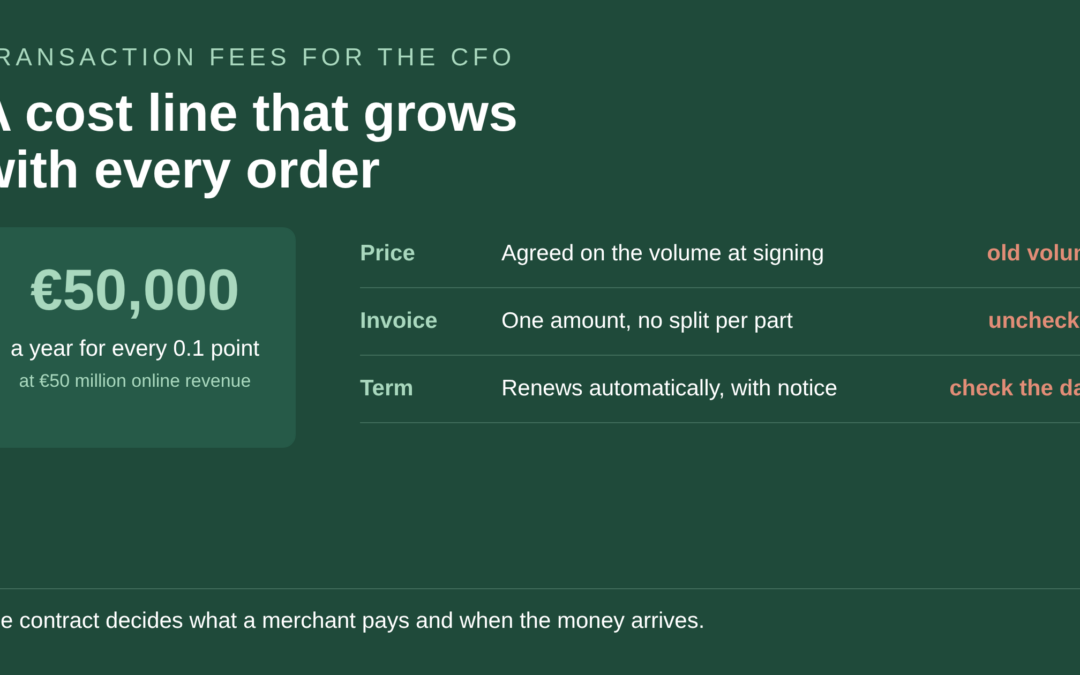
A lower payment cost goes straight to EBITDA. It needs no extra order, no extra stock and no extra marketing. For a merchant with €50 million in online revenue, every 0.1 percentage point off the total payment cost is €50,000 a year, for every year the contract runs.
To earn the same €50,000 through sales at an EBITDA margin of 5%, the business would need €1 million in additional revenue.
Which figure applies to your business follows from your own contract and invoices, not from a market average.
Eight examples of what to look at in the contract
The points below are examples, not a complete list. Each is a clause that decides what a merchant pays or when the money arrives, and each is in the contract or in the rate annex.
- One rate for everything. A single rate per transaction for all cards. The invoice then shows one figure, and the share that goes to the provider stays out of sight.
- A price on old volume. Rates agreed on the volume at signing, without tiers that lower the price as volume grows.
- Minimums. A minimum fee per transaction, or a minimum amount per month that is charged even when volume is lower.
- Fixed monthly fees. Fees for a platform, an account or a service that run regardless of the number of payments.
- Refunds and disputes. A fee per refund and per disputed payment, on top of the amount that goes back.
- Currency conversion. A margin on the conversion when payments arrive in a currency other than your settlement currency.
- Payout and reserve. How many days it takes before the money is paid out, and whether part of it is held back as a reserve.
- Price changes and renewal. Whether the provider may change prices during the term, whether the contract renews automatically, and how long the notice period is.
Each of these points can be raised with the current provider.
An invoice finance cannot check
Many PSP invoices show one amount per payment, or one total per month. Finance sees what was paid, not whether it matches the contract. Without that check, a wrong rate or a charge that should not be there can run for years.
That check means setting each line of the invoice against the contract, and recovering what was charged wrongly.
Why now: the 2027 budget
For most companies with a calendar financial year, the 2027 budget is being set now. A saving agreed in the first months of the year counts for most of 2027; for every month the contract stays as it is, the old price is paid.
In a Gartner survey of 150 CFOs published on 11 November 2026, finance leaders expect labour and other input costs to rise in 2027, while many companies have little room to pass those increases on through higher prices. A lower cost per order is a saving that needs no price increase.
It is an operational saving that holds for every year the new terms run, without a new project each year. It needs no reduction in staff, no new system and no change for the shopper in the checkout.
Check the end date and the notice period in the contract: they decide when the provider has the most reason to move.
No switch of provider, no project for your team
A renegotiation takes place with the current provider. The integration, the checkout and the settlement stay as they are, so shoppers and the finance team notice nothing. Where you prefer the provider to deal only with your own team, EcomStream works as a silent partner: it writes every message and values every proposal in euros, and the provider speaks only to you.
What it asks of your team is the contract and one month's invoice.
The work runs on no cure, no pay. Any cost for the service would come out of the actual savings realised.
What finance teams say
"Thanks to Ramon's knowledge and tenacity, we can provide our customers with better and cheaper services. Thanks for the help Ramon!" Kees Westerweele, CFO, Bax Music.
"Ramon from EcomStream has a lot of expertise in the field of payment solutions and Payment Service Providers. We have made significant savings for our online payment solutions that will benefit us for years to come. Win/win situation, no cure no pay." Ruiz Quaedvlieg, Financial Controller, TopVintage.
Start from your own contract
Send the contract and one month's invoice. Within a week you receive one page: where your terms sit against what was negotiated for comparable merchants, and what to ask for. You can request it as a second opinion, free of charge.
EcomStream renegotiates PSP costs, runs payment RFPs and manages payment performance through Managed Performance Optimisation for retailers and brands. EcomStream is independent: no PSP mandates, no acquirer partnerships and no revenue share with providers.
Payment set-up check
See where your payment set-up carries avoidable cost
A PSP contract is priced once, while your volume, card mix and markets keep moving. Enter your webshop URL: the check names what your checkout misses in each of your markets. Each point comes with the service that addresses it.
Free, no email address needed.
Swiss Sense: monthly provider costs reduced by around 20 to 25 per cent. Read the case

Client cases
Clients worked for