
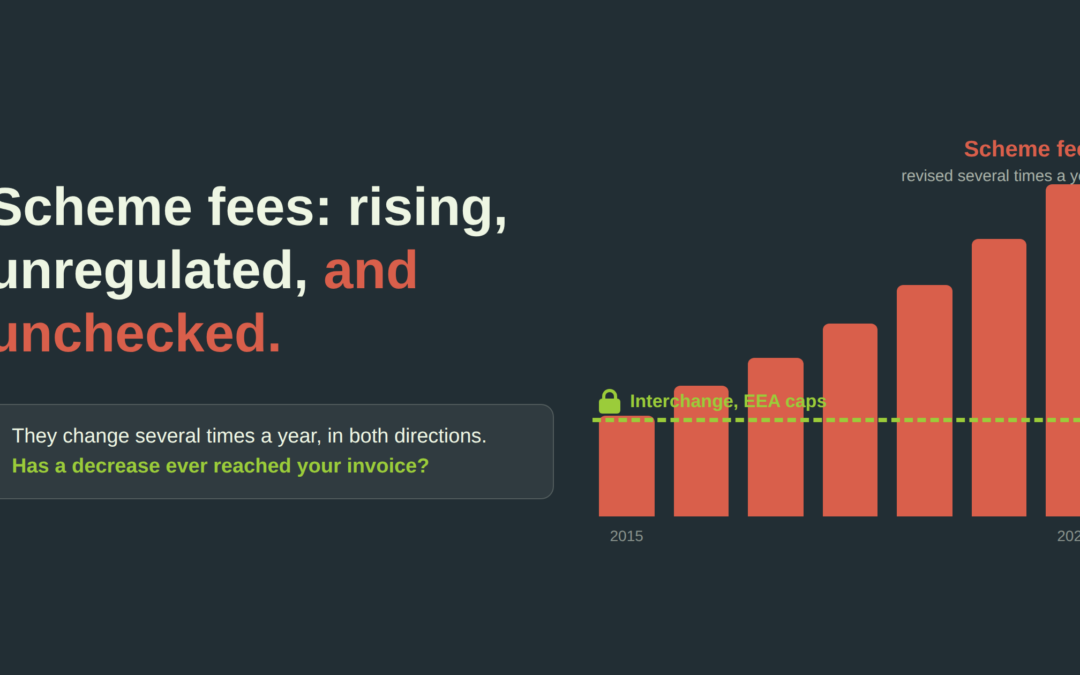
Interchange got the caps and the headlines. Scheme fees got neither, and they have been climbing quietly ever since.
Ask a merchant what a card transaction costs and you will hear about interchange, or about their PSP's rate. Almost nobody mentions scheme fees, the third component, paid to the card schemes, Visa and Mastercard foremost among them, for the use of their networks. That silence is worth money. Scheme fees have risen steadily for years, they are not regulated, they change several times a year, and on most invoices nobody, not the merchant and certainly not the PSP, is checking them.
This piece covers the cost line itself: what scheme fees are, why they keep rising, why they are so hard to read, and what a merchant can actually do about a fee that is set by two of the most powerful networks in commerce. It is one component of the full invoice; for the whole picture, start with the complete guide to PSP cost optimisation.
What scheme fees are, and where they sit
Every card transaction carries three cost layers. Interchange goes to the cardholder's issuing bank. The acquiring margin stays with your PSP. Scheme fees go to the scheme itself as the price of using its rails: authorisation, clearing, settlement, and the long tail of services around them.
Visa and Mastercard dominate European e-commerce volume, and they anchor this piece, but every scheme charges for its network. Domestic schemes such as Cartes Bancaires, girocard and Bancontact run their own fee schedules on their own rails, and for merchants with relevant volume, American Express, UnionPay and JCB each bring their own structures again. The logic below applies across all of them; only the schedules differ.
Technically the scheme charges your acquirer, and your acquirer passes the cost on to you. That pass-through construction matters, because everything you know about your scheme fees arrives filtered through your PSP's invoice. You never see the scheme's own billing. You see what your PSP says the scheme charged, which is not always the same thing, a point this piece returns to exactly once.
If interchange is the regulated, headline component and the acquiring margin is the negotiable one, scheme fees are the residual category: unregulated, unnegotiable in the direct sense, and largely unexamined. That combination is why they deserve more attention than they get, not less.
Why they keep rising
When the EU capped consumer interchange in 2015, it squeezed one end of the balloon. Card scheme revenues did not shrink to match; the growth moved to the uncapped side. Scheme fees have been the schemes' growth engine since, and the pattern is consistent: new fee types introduced, existing rates revised upward, and category definitions adjusted, with updates landing several times a year.
None of this is secret, but none of it is announced to merchants either. Scheme fee changes are communicated to acquirers in technical bulletins. Whether and how they reach your invoice depends entirely on your PSP's pass-through practice and your contract's wording. Most merchants discover a scheme fee increase, if they discover it at all, as an unexplained drift in their effective card cost, months after the change took effect.
The direction of travel matters for planning. Interchange is capped and stable only within its regulated perimeter, EEA consumer cards on the four-party schemes; commercial and non-EEA interchange is neither capped nor still, and those rates get revised too. The acquiring margin is under competitive pressure. Scheme fees are the component with structural upward momentum across the board. On a typical European card mix they now represent a serious share of total card cost, and for merchants with significant cross-border or non-EEA volume, the share is larger still, because that is where the priciest fee categories concentrate.
Why nobody can read them
Scheme fee schedules run to dozens of fee types per scheme. Some are charged per transaction, some per volume, some per event, and some, the non-transactional ones, are not tied to any sale at all: fees for reporting, for integrity programmes, for inactivity, for the privilege of specific transaction flows. Which fees apply depends on transaction characteristics that most merchants have never heard of: where the card was issued, where the transaction was acquired, how it was authenticated, what data accompanied it.
The result is a cost line that resists scrutiny by design. On blended pricing, scheme fees are invisible entirely, folded into your single rate. On interchange++ they appear as line items, but the lines are cryptic: fee codes, abbreviations, and aggregations that vary by PSP. An invoice can be technically transparent and practically unreadable at the same time, and scheme fee lines usually are.
Your PSP has no incentive to translate. Reconciling scheme fee lines against the schemes' actual schedules is real work, it earns them nothing, and, in the cases where the pass-through has been rounded generously in their favour, it costs them. No PSP audits itself on your behalf.
The check almost nobody runs
There is a discipline that answers the question in this article's title, and it is called pass-through cost verification: reconciling what you were billed, line by line, against what the schemes actually charge for your specific transaction mix, across both interchange and scheme fees.
Every interchange++ invoice makes the same implicit claim: these lines are pure pass-through, billed to you exactly as the schemes and issuers billed your PSP. Almost no merchant has ever independently tested that claim, which is remarkable for what is usually the largest cost line on the invoice. The verification tests it, and the outcome sorts into two very different categories. Charges that were never owed, a rate above the schedule, a fee applied to transactions it does not cover, are not negotiation material. They are recovered, because they should not have been there. Charges that are genuinely owed but simply expensive belong to a different conversation, the negotiation over your pricing and set-up. Knowing which of the two you are looking at changes both the tone and the leverage of the discussion with your PSP.
This is not a report you order separately; where an engagement calls for it, it is part of the work. This piece stays with the cost line itself.
Free check: did the last change reach your invoice?
Here is a check any merchant can do without specialist knowledge. Scheme fees change several times a year, in both directions; occasionally a fee is reduced or retired. Look at your effective card cost over the past two years and ask one question: have you ever seen a scheme fee decrease show up? If every change you can detect went one way, on an invoice built from a fee schedule that moves in both directions, that asymmetry is telling you something about the pass-through practice between the scheme and your invoice.
A second, simpler version: ask your PSP for the current scheme fee schedule applying to your account, with your last invoice's scheme fee lines mapped to it. The request is entirely reasonable. The response time and the completeness of what comes back are both informative.
What a merchant can actually do
You cannot negotiate scheme fees with the schemes, whether that is Visa, Mastercard or a domestic network. But the fee a scheme sets and the cost that lands on your P&L are separated by three things you do control.
The pricing model. On blended rates, scheme fees are a black box inside a black box. Moving to interchange++ makes them visible as separate lines, which is the precondition for everything else.
The contract language. Pass-through clauses vary enormously. Some contracts commit the PSP to passing scheme fees at cost; others leave room for "administration" on top. Knowing which language governs your account decides whether a scheme fee line is a fact or a claim.
The transaction mix. As with interchange, the characteristics of your transactions decide which scheme fee categories apply. Cross-border share, authentication method, and data quality all move the effective scheme fee cost, which means part of this "fixed" cost responds to how your payment set-up is configured.
Each of these is a lever a merchant can pull, and none of them requires the schemes' cooperation.
Who checks them, then?
The honest answer to the title: today, at most merchants, nobody. The PSP will not, the schemes have no reason to, and the merchant lacks the schedule access and the time. That vacuum is precisely where I work. I work exclusively for merchants and retailers, never for PSPs or acquirers, on a no cure, no pay basis, and I handle every engagement personally.
If your scheme fee lines have never been independently examined, get in touch. For a first directional read on your whole payment set-up, the PSP Upside Calculator takes a few minutes.
One conversation is enough to know whether there is anything here
A thirty-minute Teams call, on your own figures. You pay no upfront fee on any of the services. Nothing to prepare, the outline is enough.


