
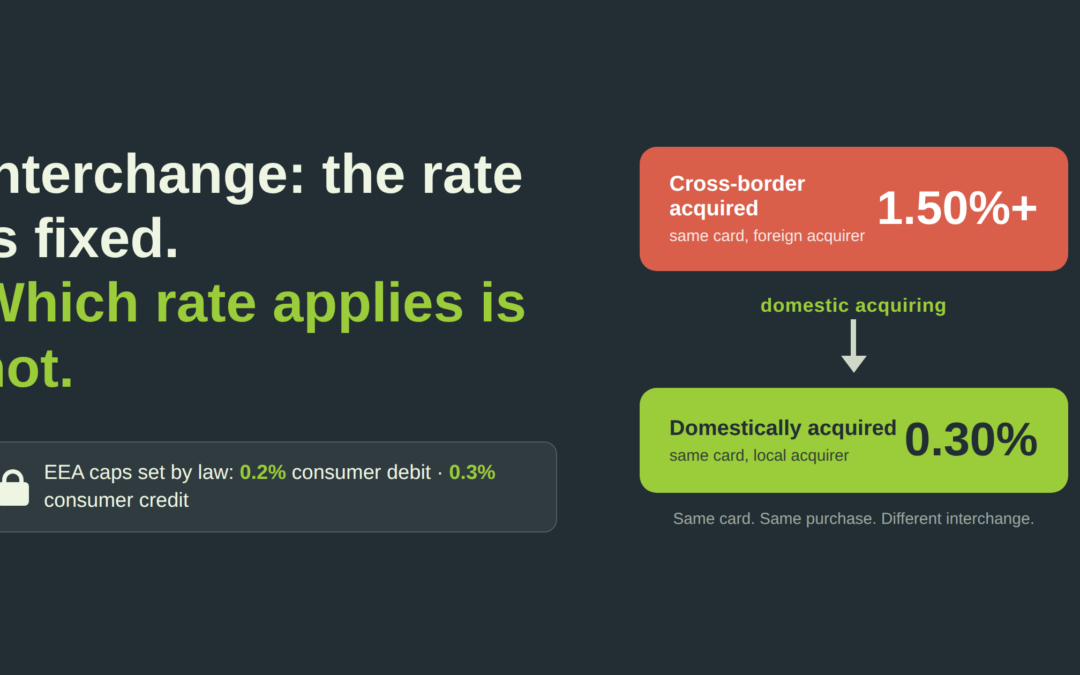
If anyone promises to negotiate your interchange down, stop the conversation. The rate cannot be negotiated. Which rate applies to you, however, can change, and that distinction is where real optimisation lives.
Interchange is the most misunderstood line in merchant payments, and the misunderstanding is expensive in both directions. Merchants waste negotiating capital trying to push on a fee that cannot move, while leaving untouched the parts of their effective interchange cost that genuinely can. Meanwhile, parts of the market happily exploit the confusion: "we will reduce your interchange" remains a common pitch, and it is a pitch that should end the meeting.
This piece sets out what interchange actually is, why nobody can negotiate it down, and where the real, legitimate room sits. It goes deeper on one component of the full cost picture; for the whole invoice, start with the complete guide to PSP cost optimisation.
What interchange is, and who actually gets it
Interchange is the fee paid on every card transaction to the cardholder's issuing bank. Not to your PSP, not to the scheme. The schemes set the rates, the issuer receives the money, and your PSP simply passes the cost through, or should.
Visa and Mastercard dominate the conversation, but they are not the whole picture. Domestic schemes carry their own interchange arrangements: Cartes Bancaires in France, girocard in Germany, Bancontact in Belgium each set rates for their own rails, and for a merchant with volume in those markets the domestic scheme's terms matter as much as the international ones. Three-party schemes such as American Express work differently again; there is no interchange in the four-party sense, only a merchant discount rate, and they sit largely outside the European caps. The principles in this piece, fixed rates, steerable mix, verifiable pass-through, apply across all of them.
Within the EEA, consumer card interchange on the four-party schemes is regulated. The Interchange Fee Regulation caps consumer debit at 0.2% of transaction value and consumer credit at 0.3%. Those caps are law, not list prices. No PSP, no consultant and no amount of volume changes them.
The caps have boundaries, and the boundaries are where your effective cost is decided. Commercial cards sit outside the regulation entirely. So do cards issued outside the EEA. A corporate Mastercard or a US-issued Visa can carry interchange several times the consumer cap, and those transactions land on the same invoice as the regulated ones. Your effective interchange is not 0.2% or 0.3%. It is the weighted outcome of every card type that passes through your checkout.
Why "we'll lower your interchange" is a red flag
Because the rates are set by the schemes and paid to issuers, there is no negotiation to be had. A PSP cannot discount interchange; it is not their revenue. When a sales deck claims interchange savings, the first question is what they actually mean. If they mean negotiating the published rates down, they either misunderstand the stack or hope you do. There is, however, one legitimate version of the claim: changing which rates apply to your transactions by changing how and where they are acquired. That is not a discount. It is structure, and it is covered below.
The distinction matters because it tells you where negotiating energy should go. The negotiable layer of a card transaction is the acquiring margin, the part your PSP keeps. Interchange and scheme fees are pass-through. A merchant who understands that walks into a renegotiation aiming at the right target; a merchant who does not spends leverage on a wall.
The part nobody mentions: effective interchange is steerable
Here is what the "interchange is fixed" truth leaves out, and what a PSP has little incentive to volunteer: while the rates are fixed, the mix is not. Your effective interchange cost responds to how transactions are composed, classified and presented.
The composition of your card mix is the largest factor. The share of commercial cards, premium consumer cards and non-EEA cards in your volume determines how far your blended interchange sits above the regulated caps. Most merchants have never seen their interchange broken down by card category, so they have no idea whether their mix is typical for their market or unusually expensive, and no way to tell whether anything drifted.
Classification is the quieter factor. How transactions are submitted to the schemes, the data that accompanies them, and how transaction types are flagged all influence which interchange category applies. Misclassification rarely announces itself. It shows up as a slightly higher rate on a category of transactions, month after month, invisible unless someone reconciles the invoice against what the classification should have produced.
The third lever is structural, and it is the one with the largest swings: where your transactions are acquired. Interchange depends not only on the card but on the relationship between the issuer's market and the acquirer's. A transaction acquired cross-border or inter-regionally carries materially higher interchange than the same card acquired domestically. For merchants with meaningful volume from outside their home market, domestic acquiring, routing that volume through an acquirer licensed in the shopper's market, moves those transactions from cross-border rates to domestic ones. This is the legitimate version of interchange optimisation: nothing is negotiated, the applicable rate itself changes. Whether your PSP supports local acquiring in your key markets, and whether it is actually switched on for your account, is worth establishing, because multi-region PSPs do not always enable it by default.
Neither drift nor structure is something a merchant is expected to police. That is exactly why the cost persists. Your PSP's incentive to audit these on your behalf is limited: the work costs them money and the finding usually costs them revenue.
The pass-through check: fixed rates still need verifying
There is a second reason "interchange is fixed" should not end the conversation. Fixed rates are only harmless if what lands on your invoice is genuinely what the schemes and issuers charged your PSP, one to one. That is what pass-through means, and it deserves verification rather than trust.
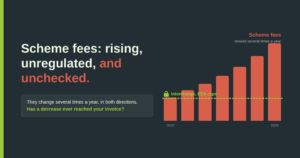
For interchange, the check is whether each transaction was billed at the published rate for its actual category. For scheme fees, the ground is murkier, and that is precisely the point. Scheme fee structures comprise dozens of fee types that change several times a year, which makes them the easiest place on the invoice to add a quiet margin under a pass-through label. A rate that is a few basis points above the true one does not look like markup. It looks like interchange.
The value of a pass-through check comes from how the billing behaves over time. Whatever pattern sits in your invoice repeats every month, on every transaction. A discrepancy found once is not a one-off correction; it is a recurring saving from the moment it is fixed, and anything charged above the true rate historically is not something to negotiate about. It should not have been there, and the conversation with your PSP is a different one when the finding is documented. This reconciliation, line by line against the published rates for your actual mix, is laborious specialist work, which is exactly why it is almost never done, and why it so often pays for itself.
Free check: can you see interchange per card type?
Take your most recent statement and ask one question. Can you see interchange as a separate line, broken down by card type, debit versus credit, consumer versus commercial, EEA versus non-EEA? If the answer is no, you are looking at a bundled number that hides the mix entirely, and you have no way of knowing what your effective interchange is, let alone whether it is right. Requesting that breakdown is the first move. Your PSP can produce it, and how readily they do is itself informative.
This check tells you whether a problem could hide. It does not tell you the size of the problem; that requires reconciling the breakdown against the published rates for your actual mix, which is specialist work.
What an independent eye does differently
An adviser who works only for merchants approaches interchange from a different starting point: nothing supply-side is taken on trust. The pass-through is verified rather than assumed, the mix is benchmarked against comparable merchants rather than against your PSP's portfolio, and the classification is checked against what the transaction data should produce. Where the effective cost is higher than the mix justifies, that gap is either recovered or corrected.
Just as importantly, an independent adviser will tell you when there is nothing to find. Interchange that reconciles cleanly is a closed line, and the attention moves to where the money actually is, usually the acquiring margin and the scheme fee treatment. That honesty is structurally unavailable to anyone whose revenue depends on selling you a follow-up.
That is the basis I work on. I work exclusively for merchants and retailers, never for PSPs or acquirers, and I handle every engagement personally. Before founding EcomStream I spent eight years on the PSP side of exactly these conversations, so I know from the inside how interchange is presented to merchants, and what it looks like when the presentation flatters the invoice.
If your interchange has never been independently verified, get in touch.
Payment set-up check
See what your payment set-up should cost at your volume
A PSP contract is priced once, while your volume, card mix and markets keep moving. Enter your webshop: the check sets your checkout against what shoppers in each of your markets expect, and names the gaps. If you want, it then calculates what those gaps cost you in euros.
Free, no email address needed, result on screen.
Swiss Sense: monthly provider costs reduced by around 20 to 25 per cent. Read the case