
Are you overpaying your PSP? Most merchants are, and most have no idea by how much. Your invoice is not a fixed cost. It is a negotiated one, and most were negotiated badly.
Most merchants treat their PSP costs like a utility bill. It arrives monthly, gets paid, and nobody looks closely at what is inside. That is exactly what payment service providers count on.
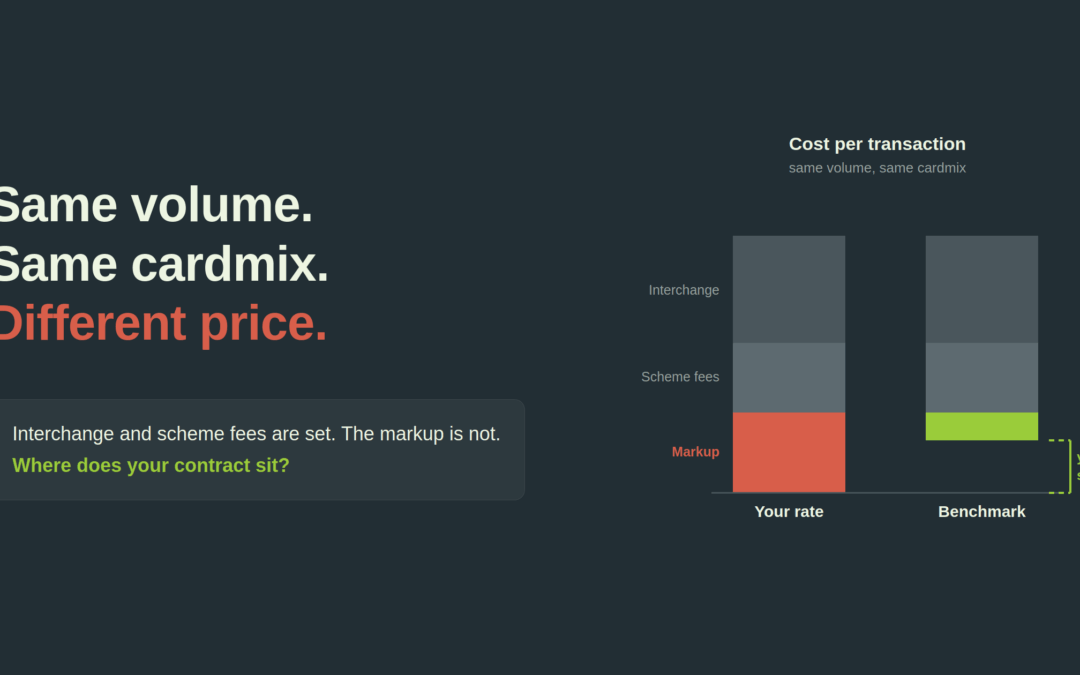
Your PSP invoice contains multiple cost components with very different levels of negotiability. Some are fixed by regulation. Some are set periodically by the international card schemes and passed through. And some are entirely at the discretion of your PSP, directly reflecting how hard the contract was pushed when it was signed.
Merchants who have never had their rates independently reviewed are almost certainly paying more than they need to. Not because their PSP is acting in bad faith, but because no PSP has any incentive to raise the question itself. That applies to a Dutch webshop with ten million euros in revenue just as much as to an international retailer or brand selling in twenty-five countries.
This is the complete guide to what makes up that invoice, across cards and every other method, where the margin hides, which components are negotiable and which are not, and how to approach the conversation with your PSP from a position of evidence rather than hope.
Your cost base is the whole invoice, not a card rate
The first instinct to correct is to think of payment cost as a single card-processing rate. For a European merchant, and a Benelux merchant in particular, cards are only one part of the cost base, and often not the largest. A typical checkout carries iDEAL, cards, possibly Bancontact for Belgian traffic, Klarna or other buy-now-pay-later options, direct debit for subscriptions, and a growing share of wallets such as Apple Pay and Google Pay. On top of the per-transaction fees sit non-transactional and ancillary charges that rarely get scrutiny at all. Each of these has its own cost structure, its own party being paid, and its own set of levers.
A merchant who has optimised their card rate to the last basis point but ignores that a third of volume runs through a high-fee method, or that the invoice is dotted with peripheral charges, has optimised the smaller number. The whole invoice is the territory.
The three components of a card transaction
Cards remain the most structurally complex method, so they are worth understanding in detail. Every card transaction carries three separate cost components, regardless of which PSP you use, and the same logic of pass-through versus margin extends, in modified form, to the other methods.
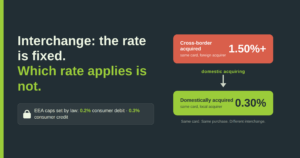
The first is interchange. This is the fee paid to the cardholder's issuing bank. For most consumer debit and credit transactions within Europe, interchange is capped by the EU Interchange Fee Regulation: consumer debit at 0.2% of transaction value, consumer credit at 0.3%. What most merchants do not realise is that interchange is not just a rate but an optimisation parameter. The composition of your card mix, the proportion of 3DS authentications, and the way transactions are classified all influence the effective interchange you pay. A higher proportion of commercial cards, premium cards, or cards issued outside the EU drives the cost up, and those categories are not subject to the caps at all. Actively steering toward a more favourable card mix and transaction classification is a part of cost management that most merchants leave entirely untouched.
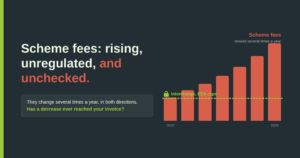
The second is scheme fees. These are charged by Visa and Mastercard for the use of their networks. They have risen significantly in recent years and now represent a serious share of total PSP costs. They change periodically and are passed through by most PSPs, sometimes at cost, sometimes with a markup. As with interchange, there is more room than merchants think. The way transactions are presented to the schemes, the mix of transaction types, and the contractual arrangements around pass-through together determine what you effectively pay. If your contract gives no clarity on this, you may be paying more than the actual rate without knowing it.
The third is the acquirer margin, what your PSP keeps for its own services: processing, settlement, reporting, risk management, and the relationship itself. This is the only component that is fully negotiable. It typically ranges from 0.10% to 0.50% per transaction depending on your business model and how effectively the contract was negotiated at the time. Most merchants have never actively pushed on this figure.
Local payment methods: a separate cost profile per market
Card transactions are not even the largest cost item for many merchants. Local payment methods, dominant in many European markets, each have their own fee structure, and PSPs exercise considerably more pricing freedom here than with cards.
In the Netherlands, iDEAL is the standard. The flat fee per transaction varies widely between PSPs, from a few cents to more than 25 cents. For merchants with high iDEAL volumes this is one of the most impactful cost items, and one of the least questioned. The economics are shifting too, as iDEAL 2.0, Visa Debit, Mastercard Debit and Wero reshape what these methods cost, which makes the assumptions baked into your current pricing worth revisiting.
In Belgium, Bancontact plays a comparable role. In France, Carte Bancaire is dominant with its own structure. In Germany, PayPal leads alongside local bank transfer solutions. Twint dominates in Switzerland, Bizum in Spain, Blik in Poland, and Swish, MobilePay and Vipps across the Nordics. Merchants selling cross-border pay separate rates for each, set by their PSP, and these rates are rarely reviewed proactively even when volume in a market grows significantly. Effective cost per method per market can deviate substantially from what is competitive.
Buy-now-pay-later methods such as Klarna and Afterpay use a different model again, typically a percentage of transaction value plus a flat fee, reflecting the credit and risk the provider takes on. A PSP can add its own margin on top of what it pays itself, and that is rarely stated explicitly in the contract. The cost impact of promoting BNPL at checkout is real and frequently unexamined.
The hidden cost items on your invoice
Beyond transaction costs, a typical PSP invoice contains items merchants rarely actively manage.
The bundling of debit and credit into a single rate line. Debit and credit cards, and variants within each, carry their own interchange and scheme fee profile. PSPs that throw every card type into one bucket and quote a single rate mask structural cost differences that can diverge further by channel, online versus POS. Without a breakdown by card type and channel, targeted optimisation is impossible, and insisting on that breakdown is often where the saving starts. The cost profile of point-of-sale payments differs from online, and unified commerce adds a further layer again.
Monthly gateway and platform fees. Fixed amounts for platform access, reporting, or account management, fully negotiable, especially at higher volumes.
Tokenisation fees. Charged for storing credentials, sometimes per token, sometimes monthly, and rarely questioned.
Chargeback and dispute fees. A fee per chargeback, sometimes on top of what the schemes charge. For sectors with higher chargeback ratios, fashion or electronics, this is a serious item.
3DS and authentication fees. Per authentication request, including for transactions that are never completed and for failed attempts. With the rollout of SCA under PSD2 these costs have risen significantly, without anyone questioning whether the rate is competitive.
Non-transactional scheme fees. Scheme charges not tied to any single sale, which sit outside the per-transaction rate and so escape attention entirely.
FX and currency conversion fees. Relevant for any cross-border merchant. Some PSPs apply a fixed spread above the mid-market rate without disclosing it, so you structurally overpay on every foreign transaction without realising.
Refund fees. A processing fee per refund. For merchants with high return rates, this adds up quickly.
Individually small, collectively material, and almost never challenged.
What your pricing model tells you
The pricing model in your contract determines how much visibility you have into all of this.
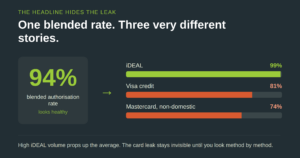
Blended pricing gives you a single percentage rate per transaction. Simple to understand, impossible to analyse. Interchange, scheme fees, and acquirer margin are bundled into one rate. You cannot see what you pay per component, which means you have nothing to benchmark and nothing to negotiate against.
The reason blended pricing costs more is the card mix that has to be factored into the single rate. Interchange varies enormously across card types: regulated consumer debit sits at the bottom, while commercial cards, premium credit, and non-EEA cards can carry interchange several times higher and escape the caps entirely. A blended rate has to be set high enough to cover the expensive end of that mix, because the PSP protects its margin against the worst-case transaction. The result is that you pay a rate calibrated for your most expensive cards on every transaction, including all the cheap domestic debit ones, and the PSP keeps the spread on each.
Interchange+ pricing (IC+) separates the acquirer margin from the rest. More transparent and more negotiable, but scheme fees are still bundled in.
Interchange++ pricing (IC++) is the most transparent model. Interchange, scheme fees, and acquirer margin are each billed as separate line items. The two plus signs are the point: the first is scheme fees passed through separately, the second is the PSP margin. This is the model used by most large European merchants. If you process meaningful volume and you are still on a blended rate, that alone is reason enough to start the conversation.
Free check: look at your most recent statement and confirm whether interchange and scheme fees appear as separate, identifiable line items. If they do not, you are on blended pricing, and the first move in any cost optimisation is to demand an unbundled breakdown. Your PSP is obliged to provide it, and the request alone often changes the tone of the conversation.
Five signs you are overpaying
- You have not renegotiated since you signed your original contract. The rate you agreed when the deal was first struck is rarely the best rate available to you now, and the longer it has gone unchallenged, the looser it tends to be.
- Your PSP has never proactively flagged a cost reduction. PSPs are not structurally incentivised to reduce your fees. If yours never has, that silence tells you something.
- You are on blended pricing with no per-transaction breakdown. Without visibility into the components, you cannot identify where the overcharge is, let alone quantify it.
- You have never received a scheme fee reconciliation. Scheme fees change periodically. If your PSP has never reconciled actual rates against what you were charged, that is telling.
- You have no benchmark. Without knowing what comparable merchants pay for comparable volume and mix, you have no leverage and no objective basis to judge whether your rates are competitive.
A note on volume, and the myth around it
It is widely assumed that volume is the lever, that bigger merchants automatically get better rates. They do not. The market is full of smaller merchants on sharper rates than far larger ones, and the reverse, because pricing reflects who negotiated well and when, not who processes the most. What you pay is largely a function of how hard the original deal was pushed and how long it has gone without challenge. Scale helps at the margin, but it is nowhere near the determinant merchants believe it to be, which is why a rate set years ago, at any size, is so often loose.
What is negotiable and what is not
A clear-eyed view starts with what cannot move. Interchange is regulated and fixed; anyone claiming they can reduce your interchange is misunderstanding the structure. Scheme fees, in their genuine pass-through form, are set by the schemes, not your PSP.
Everything your PSP controls is negotiable. The acquirer margin on cards. The margin on every other method, which because non-card rates are so rarely challenged often has more room in it than the card rate does. The pricing model itself, where moving from blended to IC++ is frequently the single largest saving available. The pricing structure of individual methods, flat fee versus percentage, which should match your basket profile. The peripheral fees, many of which can be removed entirely. And any scheme fee markup, once identified, which is not so much negotiable as recoverable, because it should not have been there.
The leverage comes from two things: knowing your numbers and knowing the benchmark. A merchant who says "I think we are paying too much" has none. A merchant who arrives with an unbundled analysis showing their margin against the market, the scheme fee lines that do not reconcile, and the charges competitors do not levy, is having an entirely different conversation. PSPs respond to evidence framed in their own data, because it is harder to dismiss and easier to escalate internally on your behalf.
There is a second, quieter source of leverage that activates the moment a specialist is involved, and it is often the more powerful. An incumbent PSP grows comfortable with a merchant who never tests the market, and that comfort is worth real money to them. It ends the instant they realise the merchant now knows what the rest of the market charges. Bringing in an independent specialist signals exactly that: the account is no longer captive, competitor pricing is now visible, and the contract is genuinely in play. An incumbent will defend margin against a merchant arguing alone. They move quickly when they sense a credible alternative is one decision away. The specialist does not have to threaten a move for the threat to register. Their presence is the signal.
The premium tier is not the answer to a cost problem
There is a move PSPs make when a merchant starts asking harder questions. Rather than reducing your cost, they offer to sell you more: a premium service tier, a performance optimisation suite, intelligent routing as a paid add-on, enhanced reporting, priority support. The pitch is that better performance and lower effective cost are available, for an additional fee.
Pause on the logic. You are being invited to pay extra for things that, in most cases, should already be part of a competently delivered service. Intelligent routing, sensible retry logic, network tokenisation, a pricing structure that matches your method mix: these are not luxuries, they are what good payment processing looks like. Packaging them as a premium upgrade is a way of charging twice, once for the processing and again for processing it properly.
There is a deeper conflict too. The entity selling you the optimisation is the same entity whose margin depends on your current arrangement. A PSP cannot be both the party you negotiate your cost down with and the independent advisor on whether their own premium tier is worth buying. Their optimisation will reliably stop at the point where it would start to reduce their own revenue. They will improve your authorisation rate, because that grows volume and their margin in absolute terms. They will not tell you your effective rate is above market, because that costs them directly. The performance side of this deserves its own scrutiny, and it is work that runs continuously rather than once: see Managed Performance Optimisation.
What an independent review delivers
An independent review goes beyond comparing transaction rates. A large part of the value lies in what is not on the front page of your invoice. PSP contracts regularly contain clauses that look unfavourable on closer inspection: automatic renewals with short notice periods, volume thresholds that trigger rate increases when not met, or pass-through clauses for scheme fees that give the PSP room to charge more than it pays itself. Merchants who have never had these reviewed carry a structural risk of costs they do not see coming.
A structured review covers four areas: pricing model analysis, benchmarking of all rates against the current market, contract review of the fine print and renewal terms, and an analysis of local payment method rates per market alongside card costs. Where the outcome points to changing provider rather than renegotiating, the next step is to run a competitive payment RFP.
The savings depend on volume, current rates, and how long those rates have gone unchallenged. For merchants processing several million euros per year, the annual impact is typically significant, and it recurs every year the improved terms hold, flowing straight to EBITDA because there is no cost of delivery against it. That is why the no cure, no pay model works: there is no fee if there is no saving.
The point is not that your PSP is acting in bad faith. It is that your PSP is acting in its own interest, and that is not the same as yours. An advisor who works exclusively for merchants, and never for PSPs, does not carry that conflict.
Where to start
The first step is insight. Not into what you are paying, but into why you are paying it and whether it is competitive. That requires an independent perspective, access to current benchmark data, and knowledge of what is standard in PSP contracts and what is not.
That inside knowledge is the difference. The arguments EcomStream brings to your PSP do not come from a textbook. They come from the PSP's own kitchen, from having built the very pricing structures and defences a merchant now faces. A merchant arguing alone works from the outside in, guessing how the PSP thinks. EcomStream argues from the inside out, knowing where the margin is hidden and how each objection is answered, because those arguments were once made from the PSP's side. The benefit also outlasts the saving: an engagement leaves your team understanding how your costs are built and where your leverage sits, insight a merchant would almost never reach alone because it lives on the PSP side of a deliberately opaque relationship.
EcomStream works with clients including Amac, Bugaboo International, Leen Bakker and Kwantum, Swiss Sense, Versuni/Philips Home Appliances, and vidaXL. Every engagement is handled personally by Ramon Helwegen, who spent eight years on the PSP sales side before founding EcomStream.
Get in touch directly.
No cure, no pay. The saving returns every month.
The objection is usually risk. Tim Schelling on a 20% saving that arrived with no investment and no change to the technical setup.
Tim Schelling, Chief Technical Officer, Vision Healthcare
Payment set-up check
See what your payment set-up should cost at your volume
A PSP contract is priced once, while your volume, card mix and markets keep moving. Enter your webshop: the check sets your checkout against what shoppers in each of your markets expect, and names the gaps. If you want, it then calculates what those gaps cost you in euros.
Free, no email address needed, result on screen.
Swiss Sense: monthly provider costs reduced by around 20 to 25 per cent. Read the case