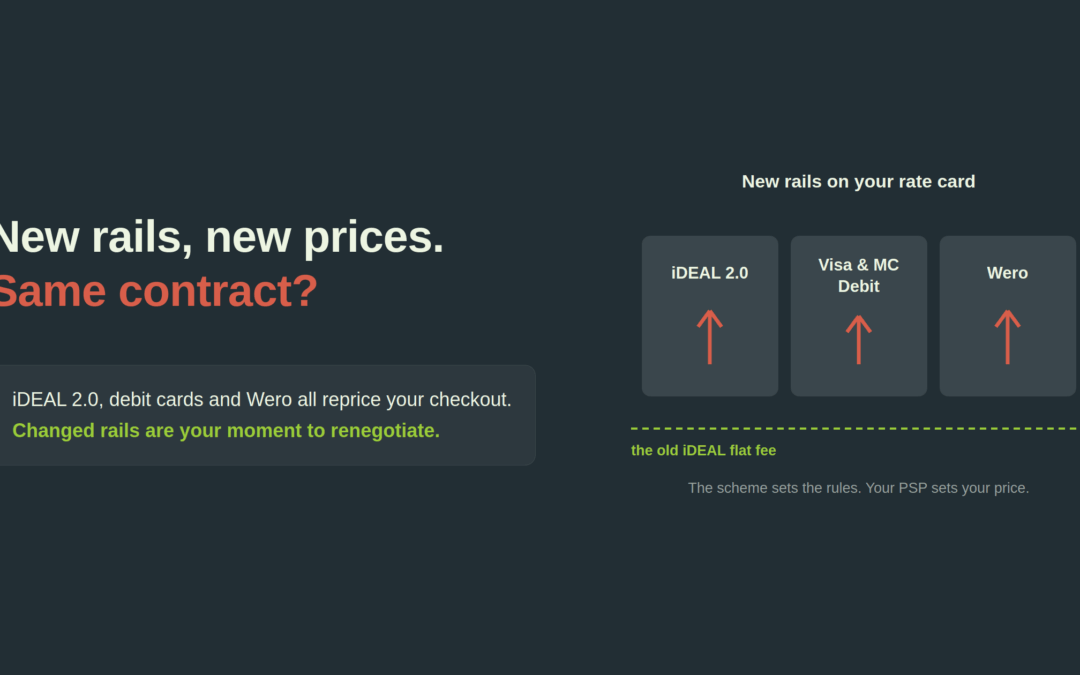
The migration from iDEAL to Wero is to complete by 31 December 2027. The migration to Wero has already started, and it reaches the merchant side from October 2026.
For two decades iDEAL has been the default way Dutch consumers pay online, and for most merchants it has been the one payment method nobody had to think about. That is changing on a published timetable. EPI restated the timetable on 15 July 2026: the market parties involved share the objective of completing the migration from iDEAL to Wero by 31 December 2027. EPI has published no date on which iDEAL itself stops working.
Consumers will barely notice. They keep paying from their own bank, in an environment they already trust. For merchants the picture is different, and the differences are commercial rather than cosmetic: a new contract, a changed dispute model, and a cost structure that is not yet settled.
What has already happened
The visible part started in January 2026. A national campaign announced the change, and from early 2026 the co-branded iDEAL | Wero logo began replacing iDEAL branding at checkout. For most merchants that happened without any work, because the payment page is hosted by the PSP and the PSP made the change.
From October 2026 all Dutch issuing banks are connected to Wero and the next migration phase begins, with iDEAL | Wero payments moving progressively onto Wero infrastructure. October 2026 is when the migration reaches the merchant side: integration and access to Wero move from announcement to action. Through 2027 the functionality widens, and the migration is to complete by 31 December 2027.
Note that the technical migration and end milestones remain subject to further alignment with De Nederlandsche Bank, so treat the phases as firm in direction and the intermediate dates as capable of moving.
The dispute model changes, and that is the part with a price on it
This is the change most merchants have not yet registered, and it is the one that reaches the P&L.
Under iDEAL there is no chargeback mechanism. A complaint is settled directly between merchant and customer, which is exactly why iDEAL carries near-zero fraud exposure for the merchant and why a fraud or risk fee on an iDEAL transaction has always been difficult to justify.
Under Wero a customer can raise a dispute weeks after the transaction. If merchant and customer do not resolve it, the PSP steps in, and where the matter persists the PSP carries liability. That is a structural shift in who holds the risk, and it has two predictable consequences. PSPs are expected to screen merchants harder at onboarding and during the relationship. And the cost of a Wero transaction may sit above what the same transaction cost as iDEAL, because there is now a risk position behind it that did not exist before.
Wero purchase protection rolls out in phases, with full coverage targeted for 1 January 2028, so the protection arrives on a different timetable from the liability.
What to ask your PSP, and when
The migration puts your payment contract back on the table whether you intend it or not, and a contract that is being reissued anyway is a contract you can negotiate. Your current iDEAL provider becomes your Wero provider and will guide the transition, which makes them the counterparty for every question below.
Four questions are worth putting to them. What will the Wero rate be, quoted against your current iDEAL rate. Who bears the cost of the new dispute process, and how is it priced. What integration work falls to you, and on what timeline. And what happens to your pricing if volume shifts between payment methods during the transition, which it will.
The timing matters more than the questions. Ask before the October 2026 phase, while your provider still wants the renewal, rather than in 2027 when the migration is a deadline and your leverage has gone.
iDEAL 2.0 pricing: the same argument, now inside a bigger one
iDEAL 2.0 introduced a wallet-style profile for guest checkout, storing IBAN and address data to speed up repeat purchases. The functionality is a genuine conversion improvement on transactions where the customer has no merchant account.
The commercial reality was always less straightforward. iDEAL 2.0 has been positioned by providers as an added-value tier, and that positioning came with a price, even though at its core it remains a bank transfer between two IBAN accounts. The underlying cost structure did not change materially; the transaction fee often did.
That argument has not gone away, it has been absorbed into a larger one. The question is no longer whether an iDEAL 2.0 uplift was justified. It is what your rate will be on Wero, and whether the number your provider quotes reflects the actual cost of the new rail or the opportunity created by a migration nobody can opt out of. EPI has said that Wero scheme pricing stays broadly aligned with the current iDEAL | Wero level until 31 December 2028, so a quoted increase before that date is a provider decision rather than a scheme one, and it is worth asking your provider to say which it is.
Mastercard Debit and Visa Debit: the parallel shift
Running alongside the Wero migration, Mastercard Debit and Visa Debit have been replacing Maestro and V Pay for Dutch consumers. The practical benefit for merchants is reach: both are globally recognised, they support one-click and recurring flows, and they enable pre-authorisation scenarios that Maestro and V Pay never reliably supported. For merchants with international customers, that removes friction which historically suppressed conversion from non-Dutch shoppers.
The commercial risk is interchange. Dutch debit interchange has been regulated at low levels and merchants benefited from that. The transition changes the fee structure, and how much of that change lands on your margin depends on how your contract is written and whether your pricing is blended or interchange-plus. Under a blended rate you will not see the shift at all until the effective rate has already moved.
What to do now
Three things, in order.
Establish what iDEAL currently costs you per transaction and what share of your volume it carries. Without that number you cannot judge any Wero quote you receive, and you will be negotiating against a figure your provider knows and you do not.
Put the questions to your provider before the October 2026 phase, while the initiative is still yours. Ask for the Wero rate in writing alongside your current iDEAL rate, and ask specifically how the dispute process is priced.
Check whether your pricing is blended or interchange-plus before the debit card transition finishes working through. On a blended rate, every one of these changes reaches you as an unexplained drift in effective cost rather than as a line you can question.
All three developments change your payment cost base, and your PSP has already modelled what they mean for their revenue. The question is whether you have done the same.
An independent read on what this costs you
What you pay is set in your PSP contract, not by the scheme, and a migration is the rare moment when that contract is genuinely open. EcomStream works exclusively for merchants, never for PSPs, acquirers or schemes, on a no cure, no pay basis, and every engagement is handled personally.
If your Wero terms are being quoted now, or your iDEAL rate has never been benchmarked, get in touch. For a first directional read on your whole payment set-up, the PSP Upside Calculator takes a few minutes.





One conversation is enough to know whether there is anything here
A thirty-minute Teams call, on your own figures. You pay no upfront fee on any of the services. Nothing to prepare, the outline is enough.


