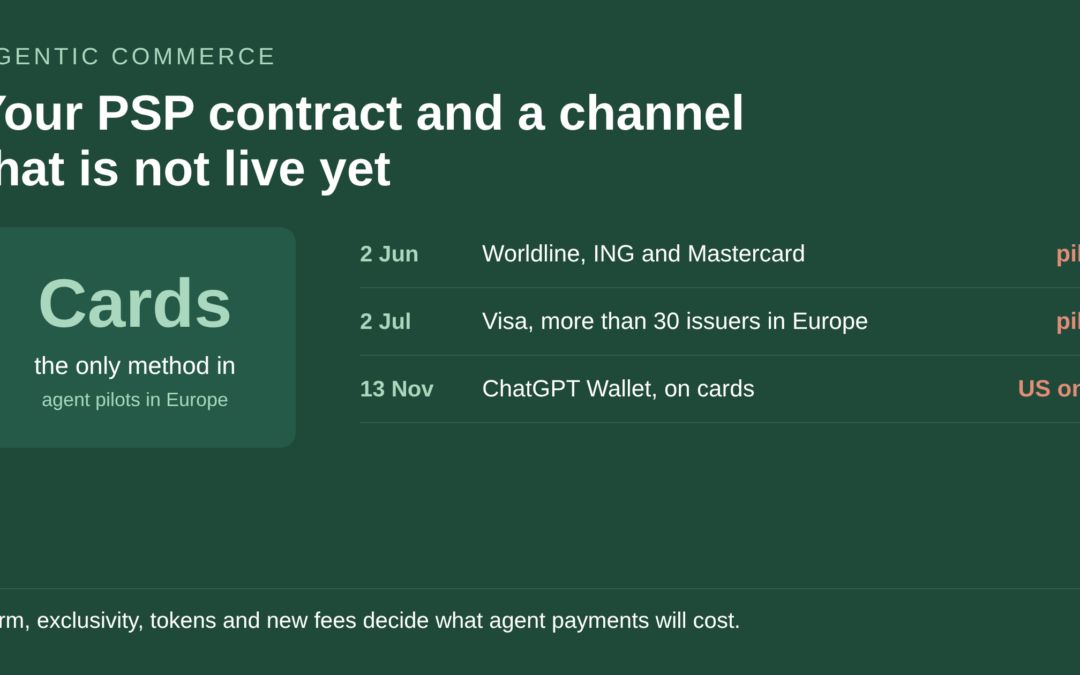
Agentic commerce and your PSP contract: keeping room for a channel that is not live yet
Card schemes have completed pilot payments by AI agents in Europe, and the large Payment Service Providers (PSPs) are building a layer to carry them. Volume is small and the rules are unfinished. A PSP contract signed this year will run through the period in which that changes, and its terms decide how much room a merchant keeps.
What runs today, and on which rails
Two layers decide how an agent buys. The card schemes' frameworks decide how an agent pays with a card. Visa's Trusted Agent Protocol (TAP) lets a merchant recognise a verified agent: the agent signs its request, and the merchant checks the signature against Visa's Agent Directory, so it can tell an approved agent from a bot. Mastercard Agent Pay issues an agentic token: the shopper's card tokenised for one agent, within the limits the shopper set, which the merchant receives and the acquirer routes like any other token. Above these sit the protocols that define how an agent talks to a merchant: the Agentic Commerce Protocol (ACP) of OpenAI and Stripe, the Universal Commerce Protocol (UCP) of Google, and the Agent Payments Protocol (AP2), an authorisation layer of signed mandates that Google donated to the FIDO Alliance in April 2026. One purchase can use both layers.
The schemes' frameworks are in pilot in Europe, in controlled programmes. Visa announced on 2 July 2026 that agents had completed purchases with more than 30 issuers, among them Barclays, Revolut and Klarna, and merchants including lastminute.com and Frasers, each payment authenticated with Visa Payment Passkeys. Mastercard states that all its issuers in Europe are enabled for Mastercard Agent Pay at network level, and Worldline, ING and Mastercard completed an agentic payment in production in June 2026. On 18 November 2026 Visa extended Agentic Ready, the programme in which issuers test agent-initiated payments, to acceptance: merchants, PSPs, acquirers and commerce platforms can now join the more than 40 European card issuers already taking part. The programme starts with more than 85 European participants, among them Adyen, Checkout.com, Mollie, Nexi, Nuvei, Stripe and Worldline, and is an environment in which agent-initiated transactions are tested and validated. None of the protocols yet gives a European merchant a checkout inside an agent: OpenAI handed checkout back to merchants' own sites in March 2026 and now pays through a card wallet in the US, and Google has given no EU date for checkout on UCP.
A merchant cannot yet know which protocol its shoppers' agents will use. A PSP that supports one protocol only, or charges per protocol, ties the merchant to a choice the market has not made.
The agent pays through the merchant's PSP
An agent platform is the service in which the shopper gives the agent its instruction, such as ChatGPT, Google Gemini and AI Mode, or Microsoft Copilot. It runs the agent, holds the conversation and the shopper's account, and in some cases stores the shopper's payment details or runs the checkout. The agent platforms do not process the payment. OpenAI's specification for delegated payments states that OpenAI is not the merchant of record, that merchants bring their own PSP, and that settlement, refunds, chargebacks and compliance stay with the merchant and its PSP. Connecting directly is reserved for PSPs and for merchants that run their own card vault at PCI DSS level 1. Every other merchant connects through a provider.
A scheme token reaches the merchant like any other token, and the acquirer routes it. Agent payments therefore arrive in the existing PSP contract, at the prices and terms already agreed there.
Why providers want this layer
Each large provider now offers one integration between the merchant and every agent platform: Stripe's Agentic Commerce Suite since 11 December 2025, Adyen Agentic since June 2026, and from the scheme side Visa's Intelligent Commerce Connect, a pilot since 8 April 2026.
The protocols are open, and each large provider supports several of them. The provider that processes agent payments therefore does not hold that volume by technology. It holds it by contract.
Published terms already show how. PayPal's terms for Store Sync, its service that feeds a merchant's catalogue to agent platforms, contain a section on PSP designation for agent checkouts. In it the merchant designates PayPal as its PSP for transactions through any agent experience, and where an agent platform asks the merchant to choose a checkout, the merchant authorises PayPal to make that choice on its behalf. Fees for agent orders follow the PayPal agreement, and PayPal may pass on variable costs of third parties. Stripe's terms for its agentic seller services, still marked as preview, have the seller authorise the agent platform to create Shared Payment Tokens (SPT) on its behalf. An SPT is a token for the shopper's payment method stored in the agent platform's Stripe account, limited to one seller, a maximum amount and an expiry date; the card number is never passed on. Shopify's terms for selling through agent platforms let Shopify assess a fee on transactions through certain platforms, at its discretion. Each of these is a standard term a merchant accepts to switch the service on, not a term it negotiated, and each decides where agent volume goes and at what price.
Four ways the agent payment chain can run
An agent payment passes four links: the shopper's agent, the party that connects the agent to the merchant, the party that processes the payment, and the merchant that pays for it. Whoever holds the connection sets the terms for the agent channel and decides which payment methods it carries. That can be the PSP, the card schemes or the agent platform. Four set-ups are visible in what runs today, and they can exist side by side. Only the second has pilot payments in Europe, and only on cards.
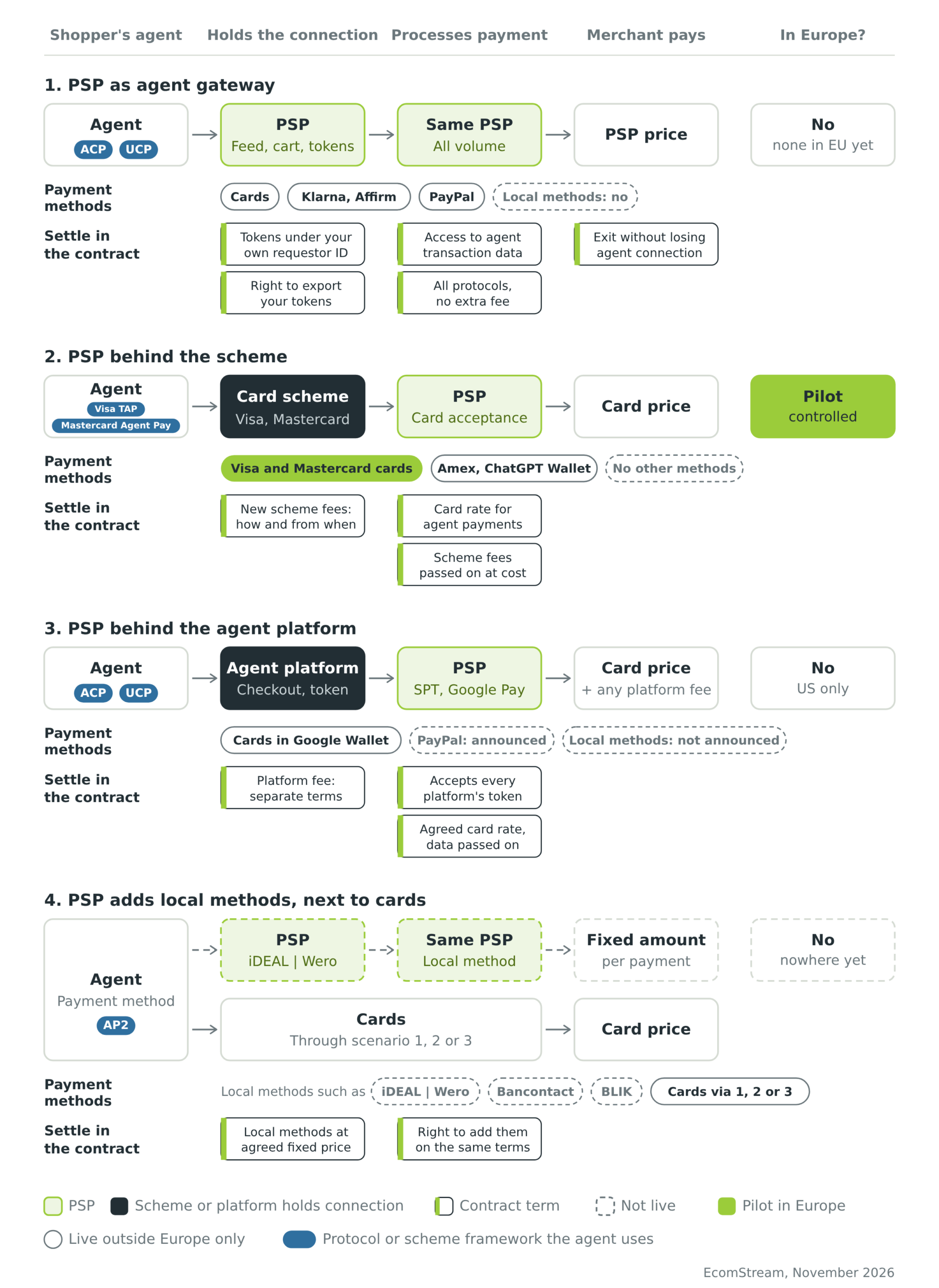
The PSP as agent gateway
The PSP connects the merchant's catalogue, cart and payments to every agent platform through one integration, and holds the product feed, the agent tokens and the transaction data for agent orders. Agent volume and ordinary volume sit with one provider, and changing provider means rebuilding the agent connection as well. In this scenario the terms on tokens, data, protocols and exit carry the most weight.
Where it runs: the products are available, mainly for the United States. Stripe lists the US, Canada and several European countries for its suite; Adyen Agentic is in limited availability for enterprise merchants in the US. No European merchant has been named as selling through an agent this way.
The PSP as processor behind the scheme
The schemes recognise the agent and issue the token: Visa through its Trusted Agent Protocol and Agent Directory, Mastercard through agentic tokens on its existing tokenisation. Visa says merchants can recognise trusted agents without overhauling their systems. The acquirer routes the token like any other card-not-present payment, and the PSP competes on the price and performance of card acceptance as it does today. Visa also offers its own entry point, Intelligent Commerce Connect, through the Visa Acceptance Platform, which places the scheme next to the PSP as a provider of the connection. In this scenario the card rate and the pass-through decide the cost. Neither scheme has published a separate fee for agent payments, but agent payments run on tokens, and the schemes are repricing the services around them in Europe: Visa introduces its Digital Commerce Services Fee, charged per authorisation, in the EU from 1 April 2027, and Mastercard revised its pricing for tokenisation and 3DS in Europe in July 2026. Whether the PSP passes such fees on at cost, and from which date, belongs in the contract.
Where it runs: pilots in Europe, in the controlled programmes above, with Cleverbridge and BrickDepot among Visa's merchants, Santander as well as ING on Mastercard's side, and Nuvei in a proof of concept with Visa and European issuers in July 2026. Since 18 November 2026 PSPs and acquirers also test in Visa's Agentic Ready how they recognise and process an agent's payment. OpenAI moved to this route on 13 November 2026 with ChatGPT Wallet, built with American Express, Mastercard and Visa: the card is charged with a token the payment network generates, and neither the agent nor the merchant sees the card number. It is available to a limited number of ChatGPT Pro subscribers in the US with a US-issued card, and OpenAI names no European date. For the merchant, OpenAI's guidance comes down to two points: the website must not block agents, and payment and risk systems must recognise legitimate agent-initiated transactions.
The PSP behind the agent platform
The agent platform runs the checkout and passes a token to the merchant. Google's UCP checkout takes payment through Google Pay, and OpenAI's in-chat checkout used Stripe's SPT. The merchant stays merchant of record and its PSP processes the payment, but the platform sets the payment methods, the shopper data the merchant receives and a fee of its own. In this scenario the PSP has the least influence on the flow, and the merchant needs a PSP that can accept the tokens of each platform it sells through.
Where it runs: live in the United States only. Google's UCP checkout is open to eligible US merchants, with Canada and Australia next and the United Kingdom later; no EU country has a date. OpenAI handed checkout in ChatGPT back to merchants' own sites in March 2026.
The PSP as integrator of local methods
AP2 is designed to work over card networks, bank transfers and stablecoins alike. The agent payments made so far run on cards. If agents start to pay with account-to-account methods such as iDEAL | Wero, the PSP that connects those methods to agent flows gains a role it does not have in the card scenarios. Card payments by agents continue alongside, through one of the first three scenarios; the method the shopper chooses decides which route an agent order takes. If it comes, it would move agent volume from card pricing back to the fixed amount per payment that most providers publishing an iDEAL price charge.
Where it runs: nowhere yet. Worldline has published a payment handler for UCP that includes European payment methods, but no agent checkout in Europe uses it, and none that takes iDEAL | Wero or Bancontact has been reported.
Each scenario points to the same contract question from a different side: the merchant keeps the right to choose, or to change, the party that carries its agent payments.
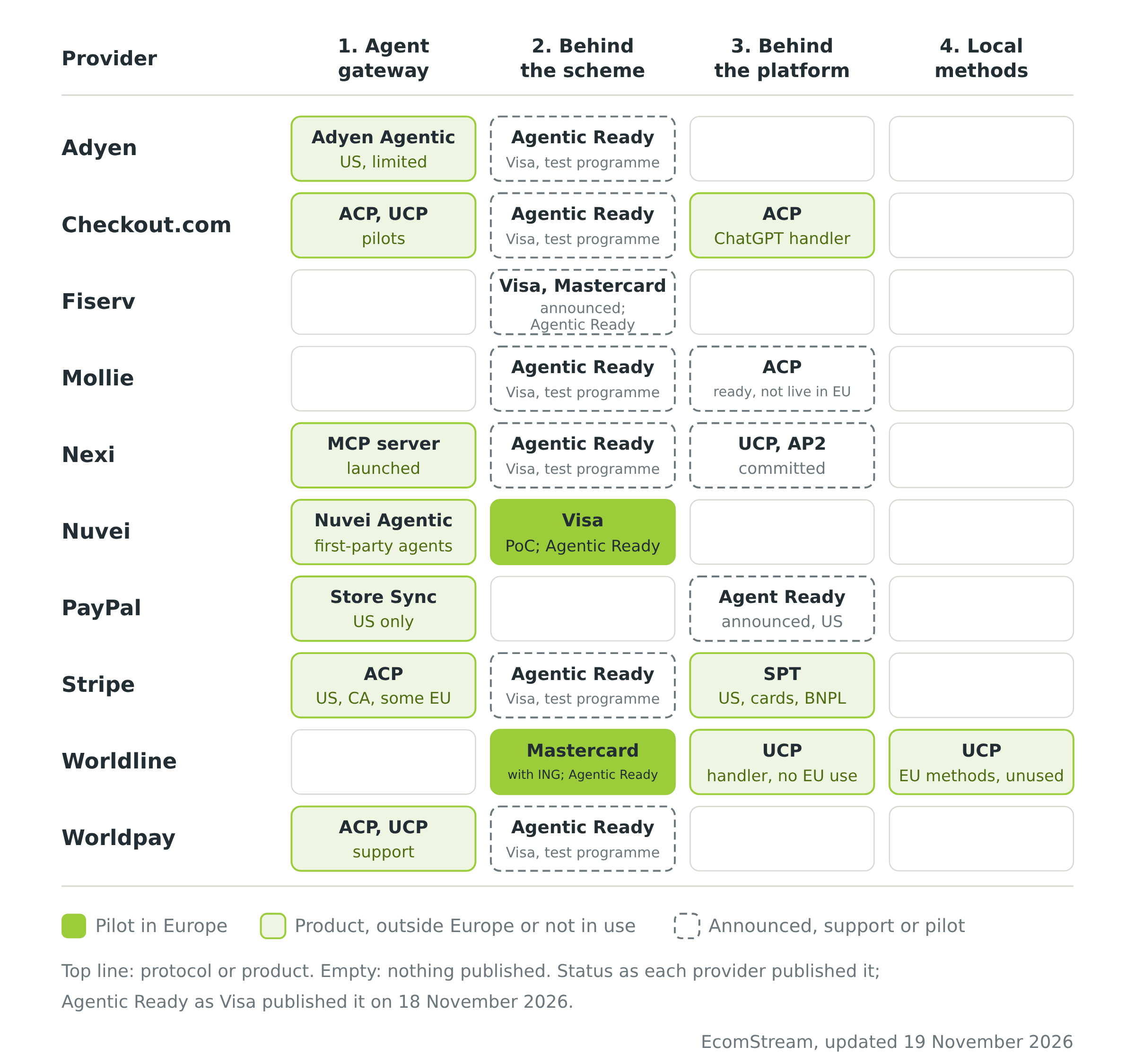
Which provider stands where
The large providers have each published something on agent payments, mostly announcements and protocol support. Only two entries have run pilot payments in Europe, and both sit behind the scheme: Nuvei's proof of concept with Visa and Worldline's payment with ING and Mastercard. Nine of the ten are on Visa's European participant list for Agentic Ready for acceptance, the test programme Visa announced on 18 November 2026; PayPal is not on that list.
Who carries a disputed agent purchase
The merchant, for now. Worldpay writes that who bears the loss in a dispute about an agent purchase remains largely undecided. Where an agent uses a correctly issued token and the payment is authenticated, fraud liability follows the usual rules for an authenticated card payment, and the cardholder keeps its chargeback rights. Where a shopper says the agent bought the wrong item or exceeded its instruction, that is a dispute and not fraud, and the current frameworks do not say who absorbs it. Agent payments carry the same dispute fees, reserves and monitoring thresholds as any other card-not-present payment in the contract.
Where the merchant has leverage in the value chain
An agent payment passes through more parties than an ordinary online payment, and each one can charge for its part. Platforms can add a fee of their own: Shopify's terms allow it to charge a fee on transactions through certain agent platforms. The card schemes charge through the acquirer, with fees for tokens and authentication that are being repriced in Europe. The PSP charges for processing and, in the gateway scenario, for the connection to the agent platforms. The issuer earns interchange as on any card payment.
Most of these layers set their price in standard terms the merchant accepts or declines as a whole. The PSP contract is the one layer a merchant negotiates, and the layer through which scheme fees reach it. What the merchant carries into that negotiation is the ability to move volume: tokens it can take along, protocols without lock-in, control over routing and a term that does not outlast the period in which agent volume takes shape. A provider prices the agent channel differently when it knows the merchant can take it elsewhere.
How much room the merchant has differs per scenario.
Scenario 1, PSP as agent gateway: room before signing, little after. The PSP holds the product feed, the agent tokens and the connection to every agent platform. Once the merchant runs its agent sales through that integration, leaving means rebuilding the feed, re-provisioning tokens and reconnecting each platform. The leverage therefore sits in the terms agreed up front: tokens under the merchant's own token requestor ID, every protocol supported at no extra fee, and an exit that keeps the agent connection.
Scenario 2, PSP behind the scheme: the most room. The card scheme recognises the agent and issues the token, and the agent payment reaches the PSP as a card payment like any other. Any acquirer that accepts scheme tokens can carry it, so the merchant negotiates the card rate, the pass-through of scheme fees and routing as it does for card acceptance today. The point to add is how and from which date new scheme fees are passed on.
Scenario 3, PSP behind the agent platform: the least room. The agent platform runs the checkout, sets the payment methods and charges its own fee in standard terms, and the merchant's choice is to sell through that platform or not. What the merchant can negotiate is the PSP side: a PSP that accepts the token of every platform it sells through, at its normal card rate, without a clause that ties agent checkouts to one provider.
Scenario 4, PSP adds local methods next to cards: room on price, once it exists. A method such as iDEAL | Wero is priced as a fixed amount per payment, which weighs less than a card percentage as the basket grows. No agent checkout takes these methods yet, so today the room consists of the right to add them to agent flows later, at the agreed fixed price and on the same terms.
What to settle in the PSP contract
None of these terms is specific to agent payments; each decides how the contract treats a channel that is not live yet.
Term and reopening. A three-year contract signed today runs through the period in which agent volume arrives or does not. A shorter term, or a clause to reopen pricing and terms once a new channel reaches an agreed share of volume, keeps that decision with the merchant.
Exclusivity. Check whether an exclusivity clause covers all volume, including channels that do not exist yet. Agent payments should not fall under exclusivity by default.
Minimum commitments. A floor on volume or fees turns a change in the payment mix into a cost. If agents move volume to another channel or another provider, the floor still applies.
New fees. Neither Visa nor Mastercard has published a separate merchant fee for agent payments, but platforms can add fees of their own, as Shopify's terms for agent platforms show. Check whether the PSP may introduce fees for new services during the term, and whether an agent payment can carry a fee of its own. The price list should say so, or say that it does not apply.
Tokens. Network tokens can survive a change of provider, but only when they are provisioned under a token requestor ID the merchant controls. Tokens provisioned under the PSP's own ID stay with the PSP. Agentic tokens are network tokens, so the same question applies to them. Put the token requestor arrangement and the right to export tokens in the contract.
Protocols. Ask which agent protocols the PSP supports today and on which roadmap, and agree that supporting a further protocol carries no separate fee and no new commitment.
Data and disputes. Agree access to transaction-level data, including the identifiers that mark a payment as agent-initiated, and which evidence the PSP passes on in a dispute about an agent purchase.
Merchant of record and routing. Adyen states that merchants keep control over customer relationships and transaction routing, and Google that the merchant remains seller of record. Those are product statements. Put merchant of record and control over routing in the contract.
Agent payments and the payment mix
The agent payments made so far run on card credentials. A merchant whose shoppers pay with iDEAL | Wero or Bancontact moves volume to card pricing with every order an agent places, so a shift in the mix belongs in the comparison of offers, also for volume that has not arrived yet. The Retail Payment Methods Transparency Index shows the prices providers publish per method and market.
Settle it in the contract
EcomStream renegotiates PSP costs, runs payment RFPs and manages payment performance through Managed Performance Optimisation for retailers and brands, and the terms above are part of that work. EcomStream is independent: no PSP mandates, no acquirer partnerships and no revenue share with providers.
Sources
Visa, Trusted Agent Protocol, 14 October 2025; OpenAI, Introducing ChatGPT Wallet, 13 November 2026; Visa, 2 July 2026; Visa, Agentic Ready for acceptance in Europe, 18 November 2026; Mastercard, Europe trusted agentic commerce; Mastercard, Agent Pay Acceptance Framework; Mastercard, Santander and Mastercard, 2 March 2026; Stripe Docs, Agentic Commerce Suite; Worldline, Worldline and ING, 2 June 2026; OpenAI, Powering product discovery in ChatGPT, 24 March 2026; Google Merchant Center Help, About UCP; Google, Universal Cart and UCP expansion; Google, AP2 donated to the FIDO Alliance, 28 April 2026; OpenAI, Delegated Payment Spec; Stripe, Agentic Commerce Suite, 11 December 2025; Adyen, Adyen Agentic, 16 June 2026; Visa, Intelligent Commerce Connect, 8 April 2026; PayPal, Store Sync terms; Stripe, Services Agreement service terms; Shopify, Agentic Storefronts Supplemental Terms of Service; Worldline, UCP payment handler, 14 September 2026; Nuvei, in-agent payment with Visa, 2 July 2026; Checkout.com, OpenAI's agentic commerce shift; Worldpay, UCP collaboration, 28 January 2026; Nexi, agentic commerce capabilities, 4 March 2026; Fiserv, Fiserv and Mastercard, 22 December 2025; Fiserv, Fiserv and Visa, 22 December 2025; Mollie, ready for agentic commerce in Europe, 19 November 2025; PayPal, agentic commerce services, 28 October 2025; Worldpay, Agentic commerce liability is still being written; PayPal, Card network updates fall 2026; Visa Acceptance Developer Center, Token Management Service.
Payment set-up check
See where your payment set-up carries avoidable cost
A PSP contract is priced once, while your volume, card mix and markets keep moving. Enter your webshop URL: the check names what your checkout misses in each of your markets. Each point comes with the service that addresses it.
Free, no email address needed.
Swiss Sense: monthly provider costs reduced by around 20 to 25 per cent. Read the case

Client cases
Clients worked for