In an ecommerce replatforming project, the payment layer is consistently the most underweighted workstream. It is also the one where a mistake costs the most, because it sits at the exact point where you convert traffic you already paid to acquire into revenue.
I have run the payment selection and integration side of enough replatforming programs to see the same pattern repeat. The platform decision gets the attention. The checkout gets whatever time is left. Then the authorization rate, the payment method mix, and the PSP contract quietly underperform for years, long after the project is signed off as a success.
If you are scoping a replatforming project, here is where the value leaks and how to keep it.
The cheapest part of the funnel gets the budget. The most expensive part does not.
Most of the design and engineering effort in a replatforming project goes to the top of the funnel. Traffic acquisition, category and product pages, the customer experience up to the basket. Everything from the cart onward tends to get treated as plumbing. Payment in particular is written off as a commodity: "we already have a PSP, it works, leave it."
That logic is backwards. The stretch from cart to confirmation is where the path to conversion is shortest and where a drop-off is most expensive. By the time a customer reaches the payment step, you have already spent the full acquisition cost to get them there. A failed authorization, a missing local payment method, or unnecessary 3DS friction does not cost you a click. It costs you the entire margin on a sale you had effectively already won.
Replatforming is the one moment you can rebuild the checkout in step with everything else, at no extra disruption to the business. Skip it and you carry the old conversion ceiling onto a new platform.
"The business will define the payment requirements" is where projects go wrong
A familiar moment in any program is the project team asking "the business" to supply the payment requirements. This is where expectations quietly fall short. For most retailers and brands, online is a sales channel, not the core operation. If the PSP that has been running for ten years still lets customers pay, the business has no reference point for what a modern checkout can now do for conversion and cost. That is not a failing on their part. It is simply not their field.
The job of the project team is to close that gap, not to outsource the decision back to people without the context to make it. Walk the owners through what has changed in checkout and payments over the past decade and tie each point to a commercial outcome. Migrating existing customers and their stored payment credentials through network tokenization so retention does not break at cutover. Removing checkout friction to lift conversion. Automating reconciliation so the finance team stops matching transactions by hand.
Done well, this also secures genuine buy-in on the chosen solution and its costs. That matters for more than politeness. It is what stops the finger-pointing if a number disappoints after go-live.
MVP is the wrong frame for the payment layer
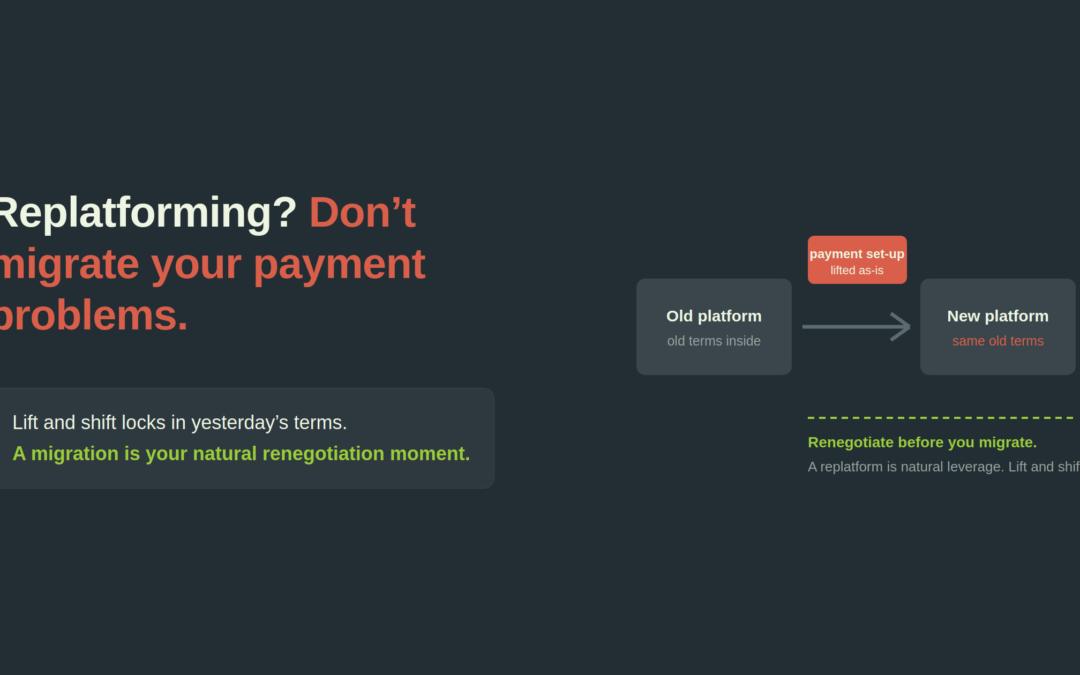
Minimum Viable Product is a reasonable approach for parts of a replatforming program. The payment layer is not one of them. If MVP is your standard at go-live, MVP is also your ceiling, and any unexpected hitch pushes you below the minimum you defined for yourself. That is a built-in path to underperformance.
A modern PSP lets you implement the full agreed set of payment methods in a single integration. There is rarely a reason to concede on this. Adding methods case by case after launch is more expensive, it reloads the project and the business with work, and the revenue you missed while a method was absent is gone for good. Go live with the complete set: cards with 3DS2, the local methods that actually drive your markets such as iDEAL and Bancontact, the relevant wallets, and BNPL where it fits the basket. The point of replatforming is to raise performance from day one, not to spend the next two quarters catching up to where you should have launched.
Watch who is steering your PSP choice
Once the platform is chosen, implementation and solution partners come in to run the rollout. They will often recommend a PSP as well, sometimes on the strength of real experience from previous builds. That reference can be genuinely useful as a best practice.
The incentive behind it is the risk. Implementation partners are frequently positioned by PSPs as a lead generation or indirect sales channel, which means the recommendation you receive may be carrying a commission you never see. A PSP selected for someone else's referral economics rather than your authorization rates and total cost of acceptance is an expensive default to inherit, and it compounds every year the contract runs.
So use the reference, but stay in the lead on the payment decision yourself, ideally by running a structured payment RFP rather than inheriting whatever the partner brought to the table. This is precisely where independent advice pays for itself. EcomStream works only for merchants. Never for PSPs or acquirers. The recommendation you get is the one your numbers justify, nothing else. And because the model is no cure, no pay, with no upfront fee and no retainer, the upside has to be real before there is ever a fee to discuss.
Build for the next regulatory cycle while you are in there
If you are replatforming now, you are also laying the foundation for the next regulatory cycle. PSD3 and the Payment Services Regulation are in their final stage, with agreed texts published and application expected around 2028. A checkout that already handles Strong Customer Authentication cleanly, applies TRA exemptions intelligently to keep friction down, and has a properly structured merchant-initiated transaction flow for recurring and one-click payments is the foundation you extend into that cycle rather than retrofit under deadline. Designing for it now is cheap. Bolting it on later is not.
Get payments right in your ecommerce replatforming
Replatforming is the rare window to get the payment layer right alongside the rest of the build, with no extra disruption. Most teams miss it, and the cost surfaces later as a lower authorization rate, a thin payment method mix, and a PSP contract nobody negotiated hard. The platform gets the credit; the checkout quietly caps the result.
If you are in a replatforming project, or about to scope one, that is the moment to get the payment layer independent of the parties selling into it. EcomStream reviews your setup from the merchant side only, every engagement handled personally by Ramon Helwegen, on a no cure, no pay basis. If you want a sense of the upside before you call, the PSP Upside Calculator gives you a number in minutes. Otherwise send a note to info@ecomstream.nl or call +31 (0)85 00 23 062 and we will take it from there.

