
Every merchant knows that checkout is where conversion happens or doesn't. What fewer act on is that checkout is also where customer relationships are built or lost. Speed is the entry ticket. Everything beyond that is where the margin is made.
Online checkout optimisation is not a one-time project. It is an ongoing commercial lever that touches authorisation rates, repeat purchase frequency, personalisation capability, and the long-term value of your customer base.
Guest Checkout vs. Account Creation
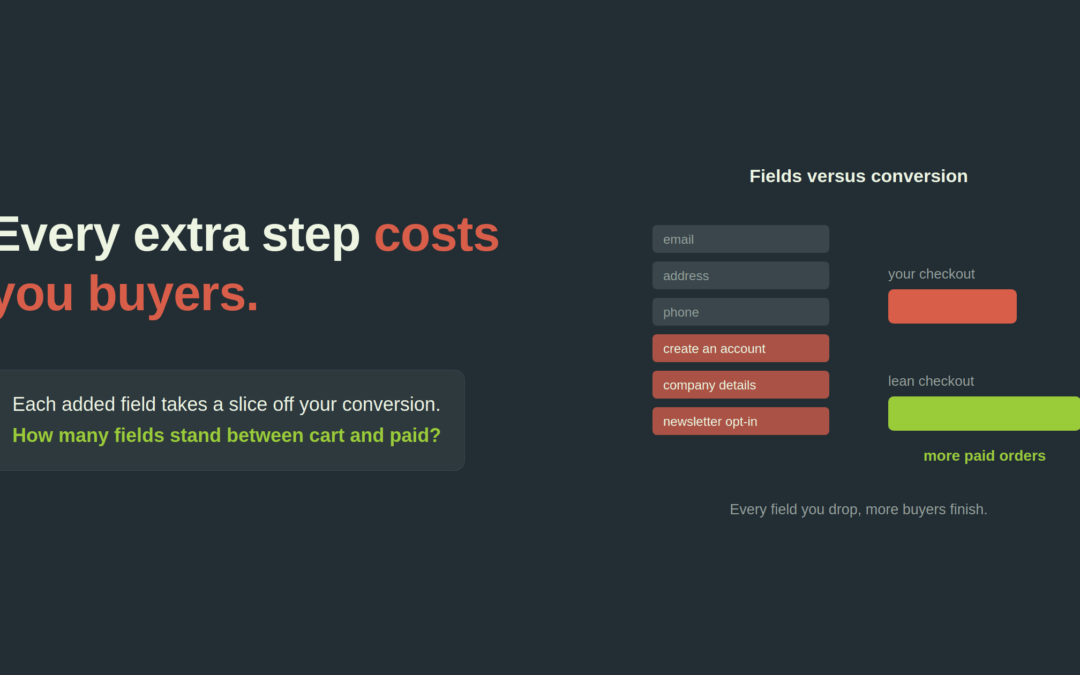
Most customers resist creating accounts. Registration friction, forgotten passwords, and forced logins suppress conversion directly and measurably. A guest checkout option is not a nice-to-have, it is a baseline requirement for any merchant running serious volume.
The trade-off is real. Guest checkout solves the short-term conversion problem while creating a long-term data problem. Without identity resolution at checkout, post-purchase personalisation becomes difficult, loyalty mechanics are harder to deploy, and your view of the shopper lifecycle stays incomplete. That cost compounds with scale.
Identity-powered checkout
The practical answer is identity-powered checkout: customers transact quickly without creating a formal account, while the merchant retains enough signal to recognise and personalise for returning buyers. Several PSPs and checkout orchestration platforms support this today via network tokenisation, wallet-based identity, or stored credential frameworks. The right implementation depends on your current stack.
First-Party Data and the Cookie Shift
The anticipated end of third-party cookies generated significant industry anxiety between 2021 and 2024. Google ultimately reversed its deprecation plan for Chrome in 2024. The hard deadline did not arrive.
The structural direction has not changed. Safari and Firefox have blocked third-party cookies for years. iOS consent changes have materially reduced signal quality across paid channels. Merchants who responded by strengthening first-party data capture at checkout are better positioned for retargeting, personalisation, and attribution. Those who waited remain exposed.
Checkout is the highest-intent moment in the customer journey. It is also the most natural point to capture first-party data with full consent. Optimising for that is both a compliance posture and a commercial one.
The Marketplace Trade-Off
Selling through Amazon, Bol or comparable platforms generates volume. It also means the marketplace controls the customer relationship. Personalisation data, retargeting capability, and lifecycle value sit on their side of the ledger, not yours.
This is a known trade-off, not a reason to avoid marketplaces. Managing it strategically means protecting your direct channel share, and checkout experience on your own domain is central to that. Payment method coverage, checkout flow quality, and post-purchase communication are where the direct relationship is reinforced or surrendered.
What Online Checkout Optimisation Actually Covers
Effective checkout optimisation spans several interconnected areas: payment method mix by market, SCA handling via TRA exemptions or merchant-initiated transaction frameworks, network tokenisation for returning customers, field logic and form design, and authorisation rate improvement at acquirer level.
The baseline tools are usability testing and A/B testing. These surface friction points that analytics alone won't show. Checkout is not a build-and-forget asset, it is one of the highest-return optimisation surfaces in ecommerce.
Beyond the checkout flow itself, your PSP contract and technical configuration have a direct impact on what is possible. Authorisation rates, retry logic, 3DS implementation, and cost per transaction all connect back to how your payment setup is structured and negotiated.
Independent Checkout and Payment Optimisation
EcomStream works with retailers and brands on checkout flow optimisation and PSP performance improvement. Every engagement is handled personally by Ramon Helwegen, with over 15 years in payments including extensive experience on the PSP side.
Engagements run on a no cure, no pay basis. No upfront fee, no retainer. If there is no measurable improvement, there is no cost.
If you want an independent assessment of where your checkout is losing conversion, or what your current payment setup is costing you relative to market, get in touch.
Further reading: how the checkout and the payment layer work as one system, in checkout flow optimisation.
One conversation is enough to know whether there is anything here
A thirty-minute Teams call, on your own figures. You pay no upfront fee on any of the services. Nothing to prepare, the outline is enough.


