
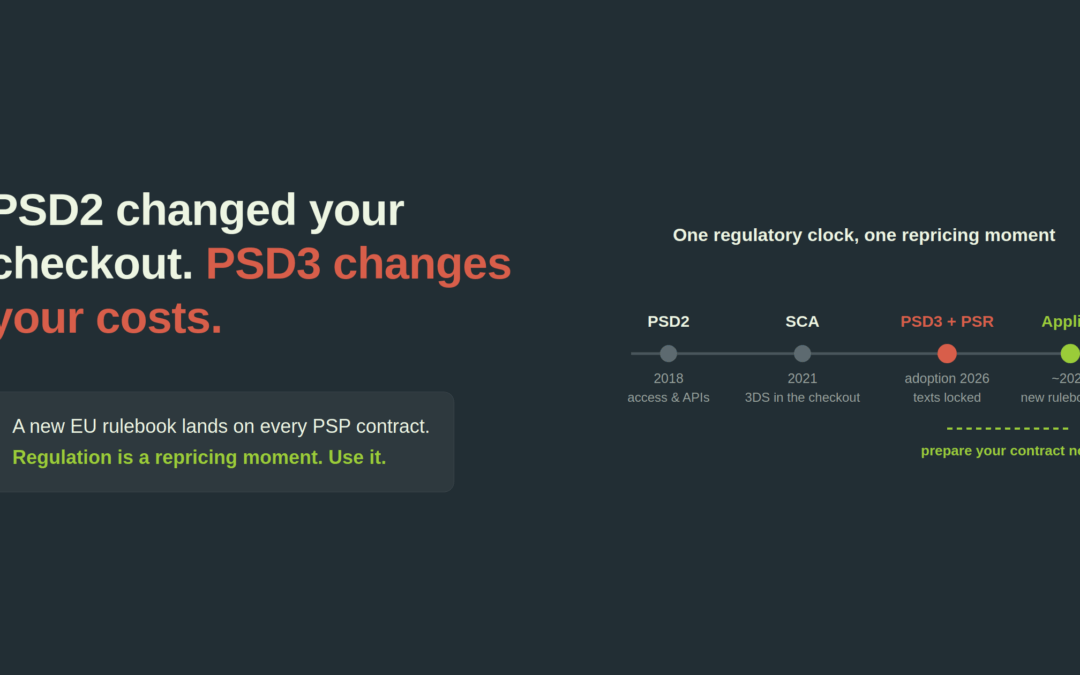
PSD2 has been the regulatory backbone of European online payments since 2019. Strong Customer Authentication, 3DS2, transaction risk analysis exemptions, by now most Dutch online retailers have absorbed the friction and adapted their checkout flows accordingly.
But PSD2 is being replaced. PSD3 and the accompanying Payment Services Regulation (PSR) are on their way, and the timeline is tighter than many retailers realise.
Where PSD2 stands today
PSD2 introduced Strong Customer Authentication as its most visible change for e-commerce. Every online transaction above €30 requires the consumer to verify their identity using two of three factors: something they know, something they have, or something they are. The intent was to reduce fraud. The side effect was checkout friction, and for many retailers, a measurable drop in conversion.
The exemptions, transaction risk analysis, low-value transactions, recurring payments, merchant-initiated transactions, provided some relief, but their application varied significantly across PSPs and acquirers. Getting the right exemption strategy in place has been, and remains, one of the most commercially valuable optimisation levers available to online retailers.
What PSD3 and the PSR change
In November 2025, the European Parliament and the Council of the EU reached provisional political agreement on PSD3 and the PSR. The Council published the final compromise texts on 23 April 2026, which fixed the content of the rules. What remains is procedural: legal-linguistic review, formal adoption by Parliament and Council, and publication in the Official Journal, expected in the second half of 2026. The rules then apply 21 months after entry into force, which realistically means 2028. The verification of payee provisions, Articles 50 and 57 of the PSR, apply 27 months after entry into force.
The most significant structural change is the introduction of the PSR as a directly applicable regulation across all EU member states. Where PSD2 required national transposition, creating fragmentation and inconsistent interpretation across markets, the PSR sets uniform rules that apply directly without the need for national legislation. For retailers operating across multiple European markets, this is a meaningful simplification.
Key changes relevant to online retailers include:
Stronger fraud liability rules. PSPs will face tighter obligations around fraud prevention and liability, particularly for APP fraud and authorised push payment scams. The liability framework shifts in ways that will affect how PSPs price their services and structure their fraud controls.
IBAN-name verification. The IBAN-name check, already introduced under the Instant Payments Regulation, becomes a standard requirement. This reduces misdirected payments but adds a verification step to payment initiation flows.
Improved SCA exemptions. The PSR refines the transaction risk analysis framework, and there is expectation that the revised rules will give retailers and PSPs more room to apply exemptions intelligently, reducing unnecessary authentication friction for low-risk transactions.
Unified licensing for payment institutions and e-money institutions. PI and EMI licences merge under PSD3, simplifying the regulatory landscape for payment service providers. For retailers, the practical impact is that their PSPs may restructure their legal entities and service agreements in the transition period.
What this means for your payment setup right now
PSD3 and the PSR will not apply before 2028 on the current timetable. But the content is now settled, so there is nothing left to wait for on substance, and the 21 month clock starts the moment the texts appear in the Official Journal. Planning against the agreed text is possible today.
For Dutch online retailers, the priority right now is not PSD3 compliance. It is making sure the current PSD2 setup is actually optimised before the new rules arrive. Authorisation rates, 3DS routing, exemption strategies, and PSP contract terms are all areas where significant value is being left on the table under the current framework.
When PSD3 and the PSR come into force, the commercial terms with your PSP will need to be renegotiated anyway. Starting that conversation now, with a clear picture of your current performance and cost base, puts you in a significantly stronger position.
The bottom line
PSD2 changed how Europeans pay online. PSD3 and the PSR change how the rules are made and enforced. For retailers, the transition is an opportunity to reset the commercial relationship with your payment providers before the new framework locks in new terms.
If you want to understand what your current PSD2 setup is actually costing you in lost conversions and excessive fees before PSD3 arrives, that is exactly what EcomStream assesses.
None of this is a compliance exercise alone. SCA exemptions, TRA thresholds and the way your provider applies them decide how much of your traffic is challenged and how much of it converts, which is why the same rules produce very different authorisation rates at two merchants of the same size. That gap is measurable, and closing it is what payment performance optimisation does.
Last reviewed 16 August 2026 against the Council's final compromise texts of 23 April 2026.
One conversation is enough to know whether there is anything here
A thirty-minute Teams call, on your own figures. You pay no upfront fee on any of the services. Nothing to prepare, the outline is enough.


