
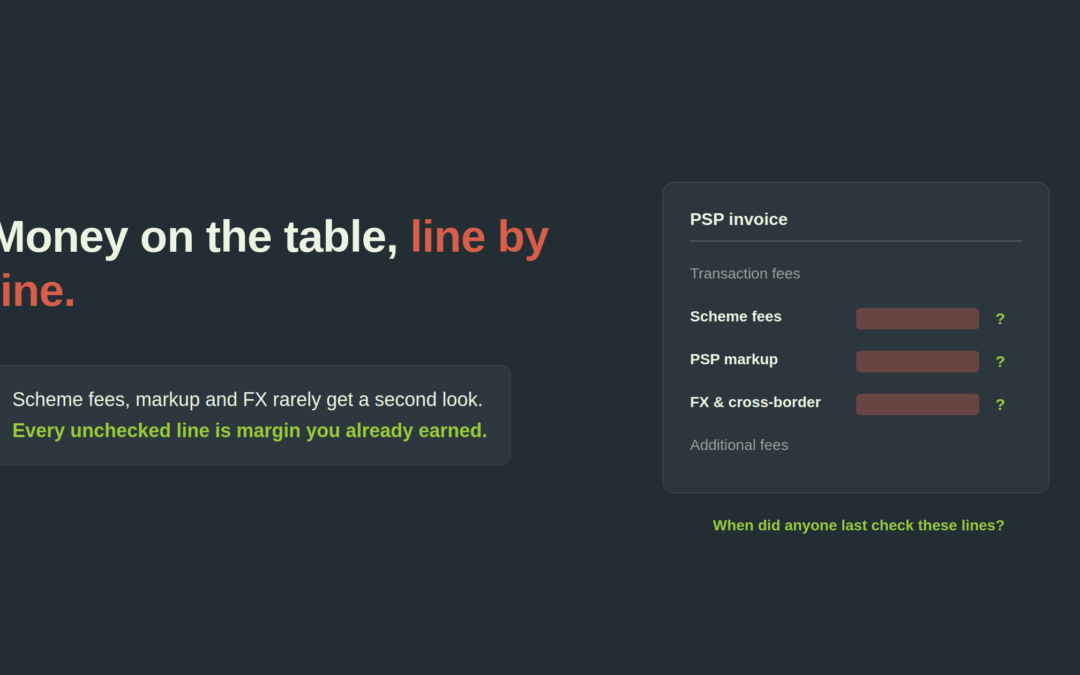
Most merchants are, and most have no idea by how much. Not because they made a bad decision, but because the payment setup that was right two years ago quietly stops being right. Volumes grow, the cardmix shifts, new methods appear at checkout, customers move to mobile, and the contract you signed keeps charging the same way it always did. The money leaks in two places at once: what you pay to accept a transaction, and how many transactions you actually convert. Both are fixable, and both are usually larger than the finance team assumes.
Where the cost leaks
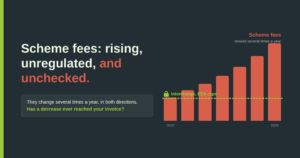
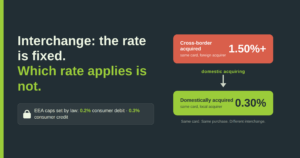
Acceptance is rarely as expensive as it looks on the invoice, and almost never as cheap as it should be. Blended pricing hides margin you cannot see, bundling interchange, scheme fees and acquirer markup into a single rate that conveniently obscures where the money goes. Interchange and scheme fees are largely fixed and the same for everyone. The acquirer markup is not, and that is where the negotiation lives. Card routing and cardmix are frequently left on default settings that suit the PSP rather than the merchant, and few merchants ever see their effective rate benchmarked against current market terms rather than the terms they were offered at signing.
This is exactly the work behind cutting your PSP costs. If your contract is approaching renewal or you suspect the rate has drifted, a structured payment RFP puts the market to work for you and replaces a comfortable incumbent relationship with genuine competitive pressure. Competition among acquirers and PSPs has intensified sharply, and the gap between a legacy contract and a sharp one is routinely material to the bottom line.
Where the conversion leaks
The more expensive leak is usually the one nobody is measuring: declined and abandoned transactions. The Baymard Institute puts the average cart abandonment rate at around 70 percent, aggregated across roughly 49 separate studies, and the largest single trigger is unexpected extra costs appearing at checkout. A meaningful share of that is recoverable through checkout design and payment configuration alone, which is precisely the territory most optimisation projects ignore.
A few points of authorisation rate is real revenue walking out of a working checkout. Soft declines that are never retried, 3DS and SCA friction that should have been waved through under a TRA exemption, merchant-initiated transactions configured to fail on the first attempt, retry logic that gives up too early. When a PSP applies a TRA exemption and the issuer declines it, the response carries a soft decline code, and the checkout must be able to detect it and escalate to a full 3DS challenge rather than simply losing the sale. Many platforms do not handle that escalation cleanly, and the lost transactions never show up as a problem because they look like ordinary customer behaviour. The exemption framework sits within the EBA's regulatory technical standards under PSD2, and using it well is a commercial lever, not just a compliance obligation. You can read the detail on the European Banking Authority's payment services pages, and the broader checkout research on Baymard's checkout usability work.
Whether you sell online, at the point of sale, or across a unified commerce estate, the same principle holds: the right payment methods presented in the right order, authorised at the highest possible rate, is the difference between a checkout that performs and one that quietly costs you. This is what getting more from your existing PSP is about. You often do not need to switch providers to recover the upside. You need someone who knows where to look.
Independent
EcomStream works exclusively for merchants. Every other party at the table, the PSP, the acquirer, the gateway, earns from the arrangement staying exactly as it is, which is the entire reason the leaks persist year after year. EcomStream earns only when you do better, so the analysis is built around your interests and nobody else's. Ramon Helwegen has been in payments since 2009, including eight years on the PSP sales side. He knows precisely where the margin is buried, because he used to put it there. The client cases show what that independence produces in practice.
No cure, no pay
There is no upfront fee, no fixed retainer, and no risk in finding out where you stand. Fees are based on results only, which means the incentive is fully aligned: EcomStream is paid a share of what it saves or earns you, and nothing if it finds nothing. Every engagement is handled personally by Ramon, from the first benchmark to the final renegotiation or migration, with no junior team learning on your account. Common questions about how this works are answered on the FAQ.
Start with the numbers
The fastest way to see whether any of this applies to you is to run the figures. Use the PSP Upside Calculator for an immediate, no-obligation estimate of what your current setup is costing you, then get in touch for a benchmark that turns that estimate into a concrete plan.
Email ramon@ecomstream.nl or call +31 (0)85 00 23 062.
Straight to: Cut your PSP costs · Run a payment RFP · Get more from your PSP · Interim work · Client cases
One conversation is enough to know whether there is anything here
A thirty-minute Teams call, on your own figures. You pay no upfront fee on any of the services. Nothing to prepare, the outline is enough.


