

In many organizations, payments are receiving more attention than ever. There are ongoing discussions about new providers, new technologies, and increasingly sophisticated ways to optimize performance at checkout. Concepts like routing, orchestration, and authorization uplift are becoming part of everyday conversations.
All of that is valid. But for many brands or retailers, it raises a more fundamental question: are we focusing on the right part of the funnel?
Because in practice, the biggest commercial gains are not found in payments. They are found before the payment even happens.
The upper- and the lower funnel
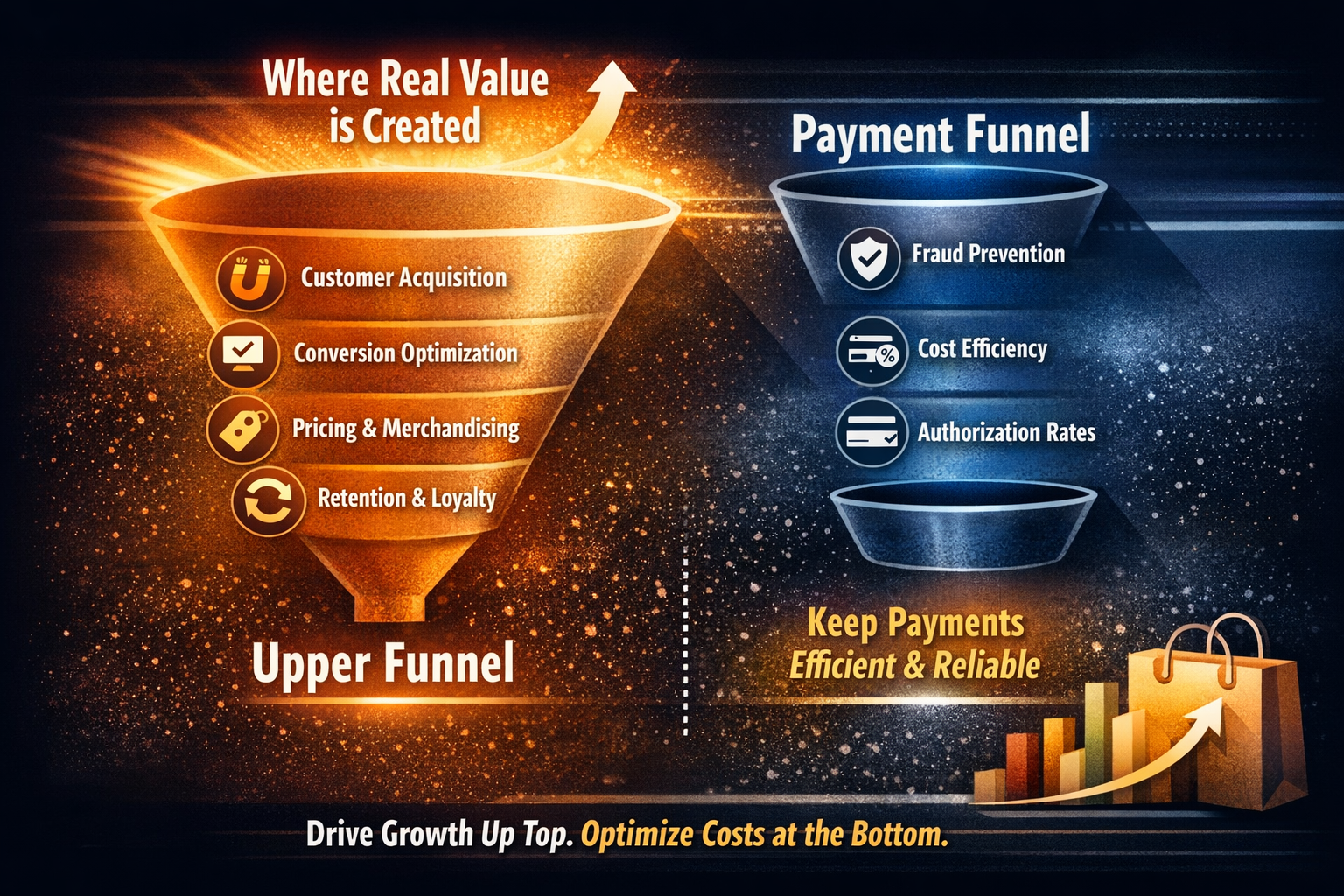
Value creation is primarily driven by customer acquisition efficiency, conversion optimization within the shopping journey, pricing and merchandising, and retention. Improvements in these areas can lead to double-digit growth. Payments, by contrast, operate within a much narrower range of impact. They influence authorization rates, fraud levels, and cost per transaction. These are important levers, but they rarely move the needle in the same way as upstream improvements.
That distinction is critical. Payments sit at the bottom of the funnel. They are the final step in a much larger value chain, and their role is fundamentally supportive. They need to work, they need to be reliable, and they need to be cost-efficient. Beyond that, the incremental gains quickly diminish.
The ‘commoditization’ of PSPs
There is a persistent narrative in the market that payment optimization can significantly increase conversion. In reality, the impact is often modest, and many PSPs give you exactly the same thing. Improvements in authorization rates or retry logic can create uplift, but typically in the range of basis points rather than percentage points. When compared to the potential impact of better UX, stronger pricing strategies, or improved targeting, the relative contribution of payments becomes clear.
This does not mean payments are unimportant. On the contrary, they are critical! But their value lies less in driving growth and more in protecting it. When payments fail, revenue is lost immediately. When they are inefficient, margins erode silently over time. This is where the real focus should be: cost efficiency and operational stability.
Payment cost optimization has a direct and measurable impact on the bottom line. Reducing acquirer markups, improving FX conditions, or eliminating inefficiencies in fee structures that seemed transparent, can result in significant savings. For many merchants, this can translate into double-digit percentage reductions in payment costs, often without any change to the customer experience. That is a rare combination of low risk and high impact.
At the same time, stability at the bottom of the funnel is non-negotiable. Payment outages, failed transactions, or poor fallback mechanisms directly translate into lost sales. Customers who encounter friction at the final step of checkout are unlikely to return. Ensuring high uptime, consistent performance, and a smooth checkout experience is therefore far more valuable than introducing additional layers of complexity in pursuit of marginal gains.
This is where organizations could risk to unintentionally overinvest. As payment setups become more sophisticated, they often require additional internal resources, more vendor management, and continuous monitoring. While this may create incremental improvements, it also consumes time and attention that could be better spent elsewhere. Every hour invested in fine-tuning payment logic is an hour not spent on improving the customer journey or driving growth.
Focus on sales
The most effective brands and retailers take a different approach. Their goal is not to build the most advanced setup, but to ensure that payments are reliable, efficient, and scalable and don’t mess up the sale. They aim for good performance levels that are competitive in the market without introducing unnecessary complexity.
This approach is reinforced by the capabilities of modern payment providers. Today’s leading PSPs already offer strong authorization performance, built-in optimization mechanisms, and global coverage. For most retailers, this delivers a level of performance that is more than sufficient. Attempting to push beyond that often leads to diminishing returns.
At the same time, the European payments landscape is evolving. Instant payments, new wallet initiatives, and digital identity developments are creating new opportunities and additional payment rails. These innovations will play an increasingly important role in the coming years, particularly in areas such as cost reduction and user experience.
However, they do not fundamentally change the role of payments within the business. They expand the toolkit, but they do not shift the priority. Adoption should therefore be driven by clear commercial benefits and customer demand, rather than by a desire to build a more complex or advanced architecture.
Companies that navigate this well tend to share a similar mindset. They do not ignore payments, but they keep them in proportion. They focus on commercial optimization rather than technical sophistication. They ensure that costs are competitive, that performance is stable, and that the checkout experience is smooth. Beyond that, they allocate their resources to areas that have a greater impact on growth.
They also maintain a degree of flexibility, but without overengineering their setup. They avoid unnecessary lock-ins in contracts, stay informed about market developments, and retain the ability to adapt when needed. At the same time, they resist the temptation to build for scenarios that may never materialize.
The bottom line
Ultimately, it comes down to prioritization. Acquisition, conversion, and retention are the primary drivers of growth and should receive the majority of focus and investment. Payments, while critical, should be managed with a different objective: ensuring efficiency, reliability, and cost control.
Payments are essential to completing the transaction, but they are not where the transaction is won. That happens earlier, in the moments where customers discover, evaluate, and decide to buy.
For most brands or retailers, the winning strategy is not maximum control over payments. It is maximum focus on growth, supported by a payment setup that simply does its job well.
Because in the end, you don’t win by having the most advanced payment infrastructure. You win by selling more, more efficiently.


