
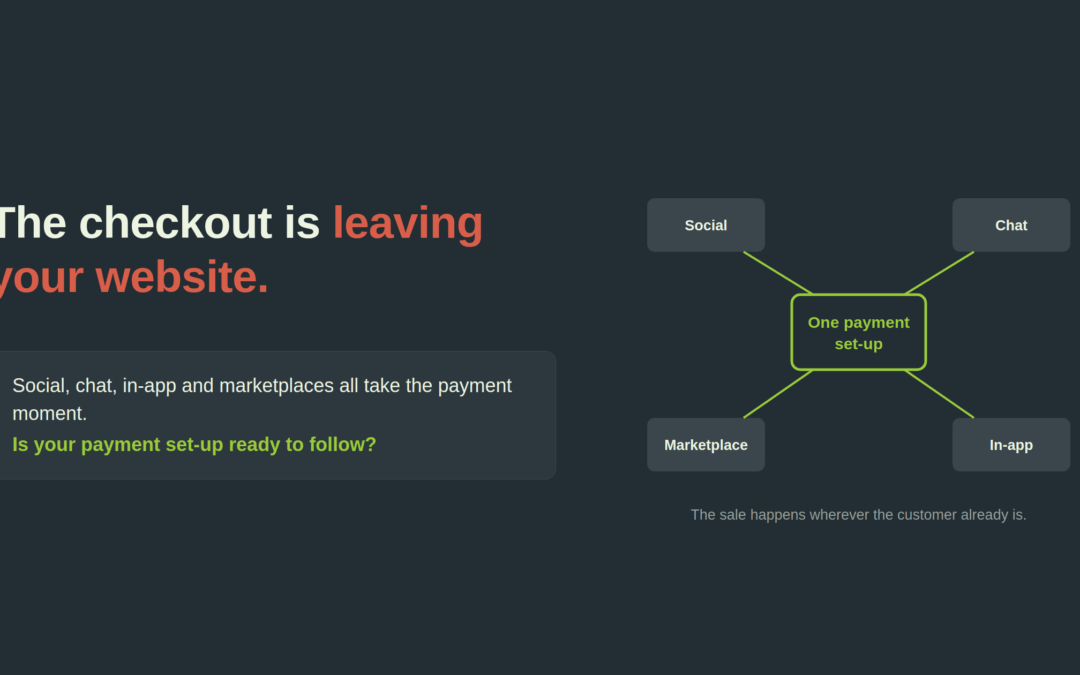
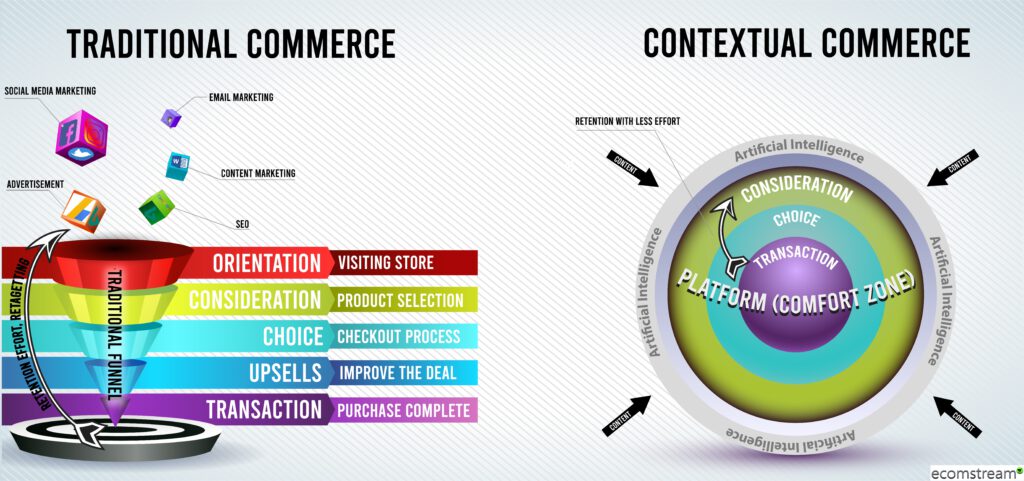
The traditional customer journey has a clear structure. A consumer discovers a product, visits a website, adds it to a cart, and completes a checkout. Every step is deliberate, and every step is a potential drop-off point.
Contextual commerce breaks that structure. It moves the point of purchase to wherever the consumer already is, whether that is a social media feed, a streaming platform, a voice interface, or a messaging app. The discovery and the transaction happen in the same moment, in the same environment, without a redirect to a separate checkout flow.
For retailers, that shift creates real commercial opportunity. It also creates a payment challenge that is often underestimated.
What contextual commerce means, with examples
Contextual commerce is not a single technology or channel. It is a principle: the purchase happens in context, without the consumer being pulled out of their current experience.
Practical examples include shoppable posts on Instagram and TikTok, where a tap on a product leads directly to a purchase without leaving the app. Buy buttons embedded in editorial content or email. Voice commerce through smart speakers. In-app purchases within loyalty or brand apps. Scan-and-go in physical retail.
What these have in common is that the payment layer is embedded rather than sequential. The consumer does not navigate to a checkout. The checkout comes to them.
The payment layer challenge
Most payment set-ups are designed for a controlled environment: your own checkout, your own domain, your own 3DS flow. Contextual commerce by definition happens outside that environment, and the payment infrastructure needs to work accordingly.
Several issues arise consistently.
Tokenisation and stored credentials
For frictionless contextual transactions, the consumer's payment credentials need to be stored and reusable without re-entry. That requires a robust tokenisation setup, ideally with network tokens rather than PSP-specific tokens, to ensure portability across channels and devices. Merchant-initiated transactions and recurring payment frameworks also play a role here where repeat purchase patterns exist.
SCA and exemption strategy
Strong Customer Authentication creates friction, and friction is the enemy of contextual commerce. Getting the exemption strategy right, particularly transaction risk analysis for low-value transactions and the trusted beneficiary exemption for repeat customers, is essential for maintaining conversion in a contextual environment. This requires active management with your PSP, not default settings.
Payment method coverage
The right payment methods vary significantly by channel and by market. A social commerce flow targeting Dutch consumers needs iDEAL coverage. A pan-European in-app purchase flow needs card schemes, wallets, and local methods configured correctly. The payment method mix needs to match the channel, not just the website.
Settlement and reconciliation
When transactions originate from multiple external environments, reconciliation becomes complex. Order references, transaction identifiers, and settlement reporting need to be structured to allow matching across channels, or finance teams end up working with unreconciled revenue.
What this means commercially
Contextual commerce reduces friction earlier in the funnel, which should increase conversion. But if the payment layer introduces friction at the point of purchase, that gain is wiped out. The investment in shoppable content or social commerce integration only pays off if the checkout experience is as seamless as the discovery experience.
This is an area where independent payment advice adds real value. The decisions around tokenisation, SCA exemption configuration, payment method selection, and multi-channel settlement architecture are technical and commercial at the same time. PSPs will give advice on these topics, but that advice is shaped by their own capabilities and commercial interests. An independent assessment looks at what is right for your specific channel mix and customer base.
Talk to us about optimising your payment set-up for contextual commerce
EcomStream helps retailers and brands optimise payment costs and performance across all channels. Independent, no-cure-no-pay, and exclusively on the merchant side.

Payment set-up check
See where shoppers in your markets drop out before they pay
A declined payment or a missing method loses an order your marketing has already paid for. Enter your webshop: the check sets your checkout against what shoppers in each of your markets expect, and names the gaps. If you want, it then calculates what those gaps cost you in euros.
Free, no email address needed, result on screen.
Versuni (Philips Home Appliances): a recurring reduction in PSP costs of more than 30%. Read the case